
If you are reading this, you are probably trying to answer one deceptively simple question: where on earth should I launch a tokenization platform that will still be legal, bankable, and taxable at a sane rate next year? The answer, for an increasing majority of founders, fund managers, and fintech CFOs, is the United Arab Emirates. And not just because the weather is better than Zug.
This is the most complete, honest, founder-grade guide to setting up a tokenization business in the UAE in 2026, plus scaling across the GCC and wider MENA. We have rebuilt it from the ground up to reflect the big January 1, 2026 regulatory reset (yes, the SCA is now the CMA, more on that in a minute), the VARA Rulebook V2.0 refinements, the ARVA category for tokenized real assets, and Dubai Land Department’s Phase 2 secondary market that went live on February 20, 2026.
TL;DR: The 60-Second Answer
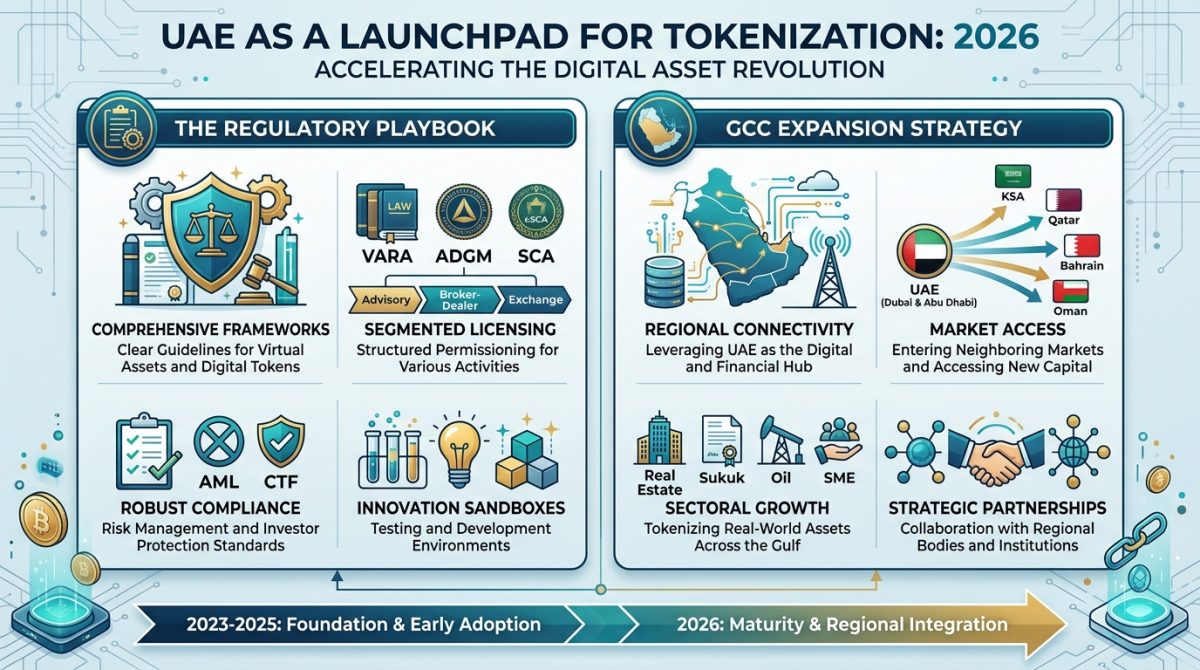
- The UAE now runs a genuinely multi-regulator virtual assets regime: CMA (federal, formerly SCA), VARA (Dubai outside DIFC), FSRA (ADGM), DFSA (DIFC), and CBUAE for payment tokens.
- The CMA replaced the SCA on January 1, 2026 under Federal Decree-Laws 32 and 33 of 2025, bringing virtual assets squarely into the federal capital markets perimeter with extraterritorial reach.
- VARA has 7 licensed activities plus issuance categories, with a two-step (ATI, then full license) process and capital from AED 100k to 1.5M+ per activity.
- Tokenized real estate is already live: Dubai Land Department’s pilot with Prypco Mint and Ctrl Alt, recorded on the XRP Ledger, opened secondary trading in February 2026 for 7.8 million tokens across 10 properties.
- VAT on crypto trading, conversion, and custody is exempt (Cabinet Decision 100/2024, retroactive to Jan 1, 2018). Mining is not exempt.
- Corporate tax is 9% above AED 375k, with 0% for qualifying free-zone income.
- Despite the GCC working toward harmonization, there is still no crypto passporting regime. Each country (Bahrain, Saudi Arabia, Oman, Qatar) needs separate handling.
If you want the longer story and the parts that will actually save you six months of wasted work, keep scrolling.
Why the UAE Won the Regional Tokenization Race
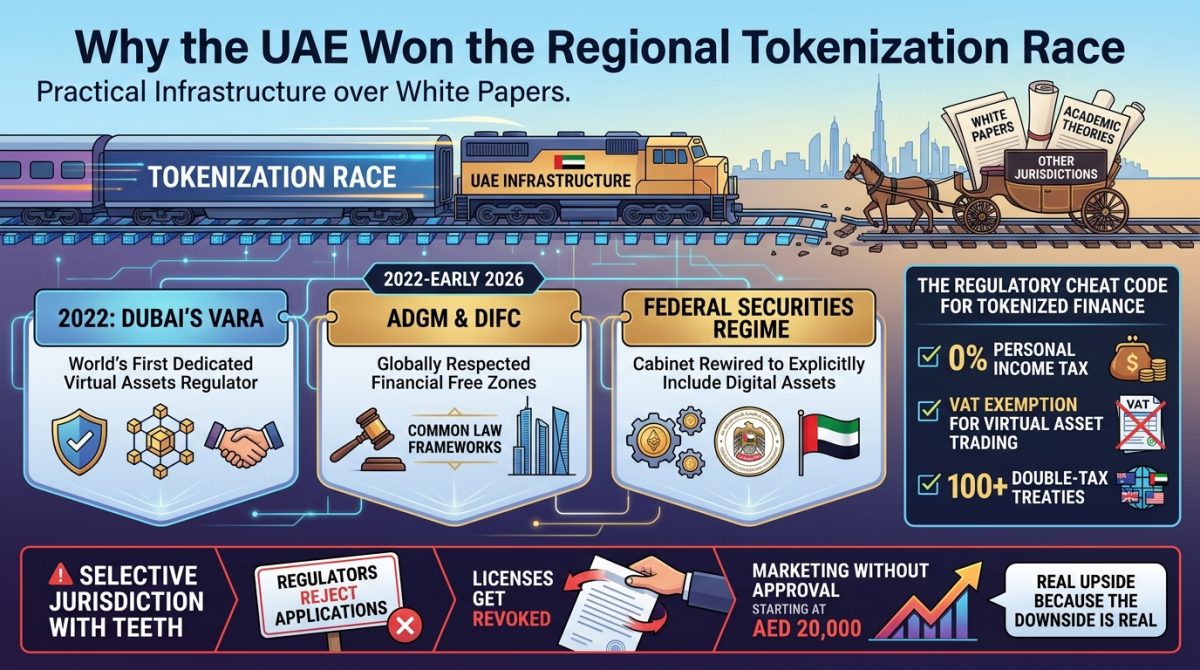
Other jurisdictions wrote white papers. The UAE shipped infrastructure.
Between 2022 and early 2026, three things happened in rapid succession: Dubai created the world’s first dedicated virtual assets regulator (VARA); ADGM and DIFC built globally respected financial free zones with common-law frameworks; and the UAE Cabinet rewired the federal securities regime to explicitly include digital assets. Layer on 0% personal income tax, a VAT exemption for virtual asset trading, and 100+ double-tax treaties, and you have something close to a regulatory cheat code for tokenized finance.
But the UAE is not a lottery ticket. It is a selective jurisdiction with teeth. Regulators reject applications. Licenses get revoked. Marketing without approval attracts fines that start at AED 20,000 and climb fast. The upside for serious founders is precisely because the downside is real for everyone else.
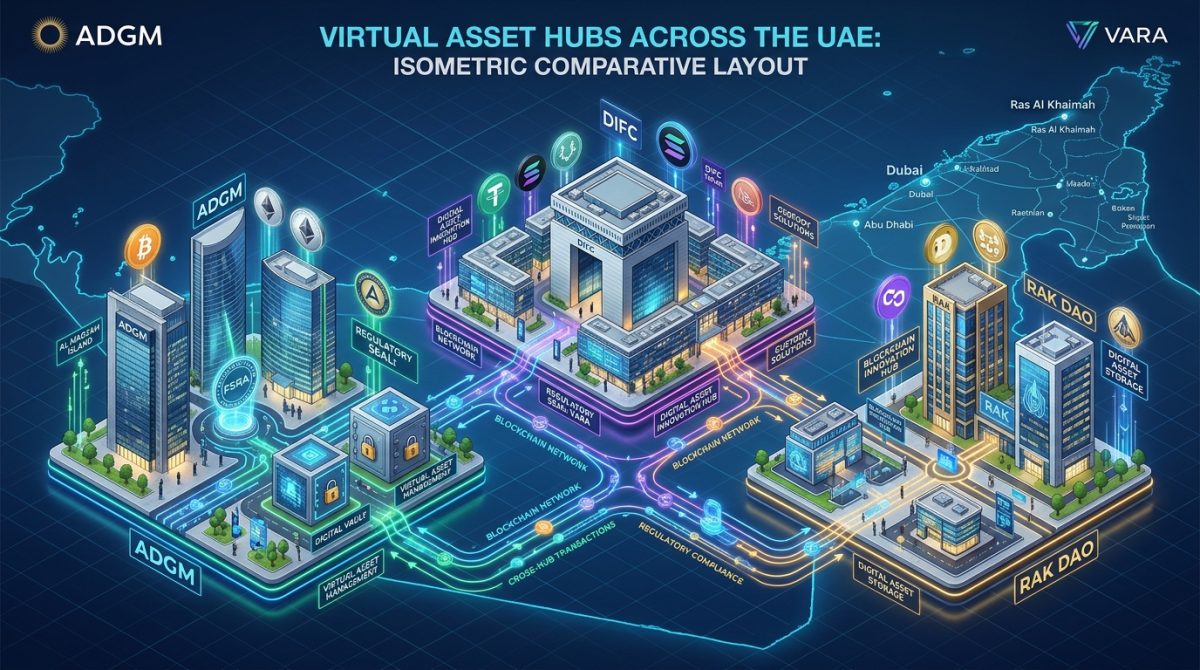
The 2026 Regulator Map (and What Each One Actually Does)
1. CMA (Capital Market Authority) – Federal
The artist formerly known as SCA. Effective January 1, 2026, Federal Decree-Law No. 32 of 2025 reconstituted the Securities and Commodities Authority as the Capital Market Authority (CMA), an independent federal authority reporting directly to the UAE Cabinet. Virtual assets used for investment purposes are now categorically a “Financial Product” under federal law.
What this changes in practice:
- Extraterritorial reach. The CMA can assert jurisdiction over activities conducted from free zones (including ADGM and DIFC) or even from abroad if there is a “UAE nexus.”
- Dual compliance (for now). Free-zone VASPs continue to answer to FSRA or DFSA, but may also need CMA recognition for marketing or listing to onshore clients during a transitional period to January 1, 2027.
- Heavier sanctions. Administrative fines up to AED 200 million for serious breaches (previously capped far lower).
- Token admissibility list. Trading a virtual asset in the UAE is prohibited unless it is accepted onto the official CMA list.
A crypto exchange operating on UAE mainland (outside DIFC or ADGM) typically requires a CMA Virtual Asset Platform Operator license with minimum paid-up capital of AED 1,000,000, plus six months of operating expense coverage. Exchanges seeking authorization across all activities are looking at AED 5,000,000 minimum.
2. VARA – Dubai (Excluding DIFC)
Created under Dubai Law No. 4 of 2022, VARA is the world’s first tailor-made virtual assets regulator. Its Full Market Product Regulations (Rulebook V2.0) cover 7 primary licensed activities plus VA Issuance:
- Advisory Services
- Broker-Dealer Services
- Custody Services (must be a separate legal entity, no combination allowed)
- Exchange Services
- Lending and Borrowing Services
- Management and Investment Services
- Transfer and Settlement Services
- VA Issuance (Category 1 VA, plus the newer ARVA for asset-referenced tokens and FRVA for fiat-referenced virtual assets)
Process: Submit an Initial Disclosure Questionnaire (IDQ) through your commercial licensor (DET or a Dubai free zone), receive Approval to Incorporate (ATI), then complete the full VASP application. Typical timeline: 3 to 6 months end-to-end. Each applicant must appoint two Responsible Individuals who are UAE residents or UAE passport holders.
Capital requirements: Roughly AED 100k to 1.5M per activity, with fees around AED 40k to 100k (application) and AED 80k to 200k (annual). Capital must be held in a UAE bank trust account or surety bond.
3. FSRA (ADGM) – Abu Dhabi Global Market
A common-law jurisdiction with one of the most mature virtual asset frameworks globally. ADGM’s FSRA regulates Virtual Assets and separately Fiat-Referenced Tokens (FRTs) as of the 2025 update. Only FSRA-accepted tokens can be used in licensed activities. Capital is risk-based, with custodians typically starting around USD 250,000. Timeline: 3 to 6 months. This is where Binance went for its “gold standard” license and where institutional capital tends to feel at home.
4. DFSA (DIFC) – Dubai International Financial Centre
The DFSA runs parallel Crypto Token and Investment Token regimes. In June 2025, it launched a dedicated Tokenisation Regulatory Sandbox for firms exploring tokenized investment products. In early 2026, it retired its public list of “Recognised Tokens” and instead requires firms to conduct documented suitability assessments. Fees run USD 15k to 70k plus per-token recognition fees.
5. CBUAE – Central Bank of the UAE
Regulates the Payment Token Services Regulation (PTSR): any payment token activity (issuing, exchanging, or providing custody for payment tokens) requires CBUAE authorization. If your stablecoin is AED-referenced, you answer to the Central Bank, not VARA. The CBUAE is also piloting the Digital Dirham and the mBridge cross-border CBDC corridor.
6. Free Zones Worth Knowing
| Free Zone | Best For | Notable Features |
| ADGM | Institutional, funds, custody | Common law, FSRA oversight, Binance’s global HQ |
| DIFC | Tokenization sandbox, fintech | DFSA, English law, Ripple’s regional HQ |
| DMCC Crypto Centre | Crypto startups, mining hosting | 100% foreign ownership, lighter setup |
| RAK DAO | Early-stage Web3 builders | “Digital Oasis” positioning, quick setup |
| Dubai Silicon Oasis / DWTC | Blockchain tech, infrastructure | VARA-adjacent |
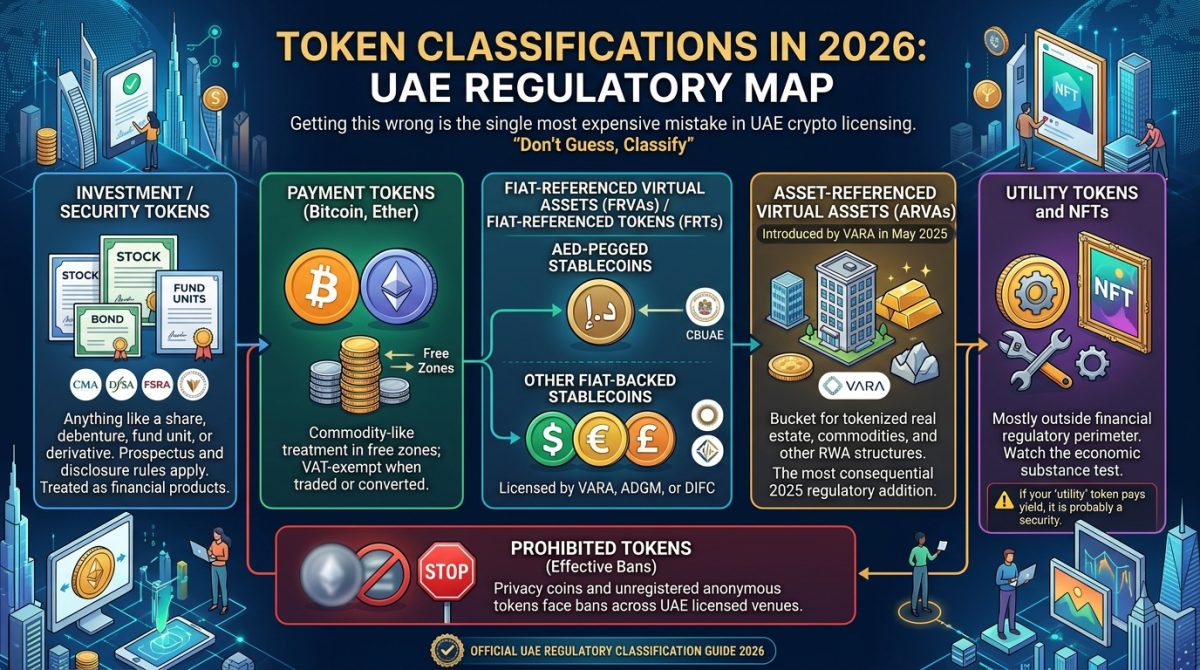
Token Classifications in 2026 (Don’t Guess, Classify)
Getting this wrong is the single most expensive mistake in UAE crypto licensing. Here is the plain-English map:
- Investment / Security Tokens: Anything that behaves like a share, debenture, fund unit, or derivative falls under CMA, DFSA, or FSRA as a financial product. Prospectus and disclosure rules apply.
- Payment Tokens (Bitcoin, Ether): Commodity-like treatment in free zones; VAT-exempt when traded or converted.
- Fiat-Referenced Virtual Assets (FRVAs) / Fiat-Referenced Tokens (FRTs): AED-pegged stablecoins go to CBUAE. Other fiat-backed stablecoins can be licensed by VARA, ADGM, or DIFC.
- Asset-Referenced Virtual Assets (ARVAs): Introduced by VARA in May 2025, this is the bucket for tokenized real estate, tokenized commodities, and other real-world-asset (RWA) structures. This is the most consequential 2025 regulatory addition for tokenization platforms.
- Utility Tokens and NFTs: Mostly outside the financial regulatory perimeter, but watch the economic substance test. If your “utility” token pays yield, it is probably a security.
- Prohibited tokens: Privacy coins and unregistered anonymous tokens face effective bans across UAE licensed venues.
The Real Numbers: Capital, Fees, Timelines (April 2026)
| Jurisdiction | License Type | Min Capital | App Fee | Annual Fee | Review Time |
| CMA (federal mainland) | VA Platform Operator | AED 1M (single) to 5M (all activities) | AED 55k to 500k | AED 20k to 50k+ | 6 to 12 months |
| VARA (Dubai) | Per activity | AED 100k to 1.5M | AED 40k to 100k | AED 80k to 200k | 3 to 6 months |
| FSRA (ADGM) | Full VASP or Limited | Risk-based (~USD 250k+ custody) | USD 20k to 40k | USD 15k to 50k | 3 to 6 months |
| DFSA (DIFC) | Crypto/Investment Token | Risk-based | USD 15k to 70k | USD 15k to 50k | 6 to 9 months |
| DMCC | Fintech license | AED 100k+ | AED 10k to 15k+ | AED 10k to 20k+ | 2 to 4 months |
| RAK DAO | VASP | AED 100k to 1M+ | USD 4.5k to 9.5k + CMA fees | USD 5k to 10k | 6 to 8 months |
Numbers are reasonable 2026 ranges and will vary by activity scope. Always budget a 20% to 30% buffer and assume your banking timeline will run parallel (and sometimes longer) than your license.
Taxation: The Grown-Up Conversation
- Corporate Tax (2026): 9% on taxable profits above AED 375,000. Qualifying free-zone income may enjoy the 0% rate if substance tests are met.
- VAT: Cabinet Decision No. 100 of 2024 amended Article 42 of the Executive Regulation, making the transfer, conversion, and management of virtual assets VAT-exempt, retroactive to January 1, 2018. The exemption does not cover mining (per FTA clarification VATP039 in January 2025), and fee-based services that include explicit charges may still be taxable.
- Personal income tax: None. UAE residents keep their capital gains.
- Withholding tax: No withholding on crypto trading proceeds; standard 0% or 9% treaty rules apply to interest and royalties.
- CARF alignment: The UAE is preparing to implement the OECD’s Crypto-Asset Reporting Framework, meaning automatic international tax information exchange is coming.
And yes, mining is legal in the UAE. The source materials you may be reading that claim otherwise are out of date. The restrictions that do exist are around zoning (no mining on agricultural land using subsidized electricity) and energy compliance. Phoenix Group, an Abu Dhabi-listed miner, is the poster child.
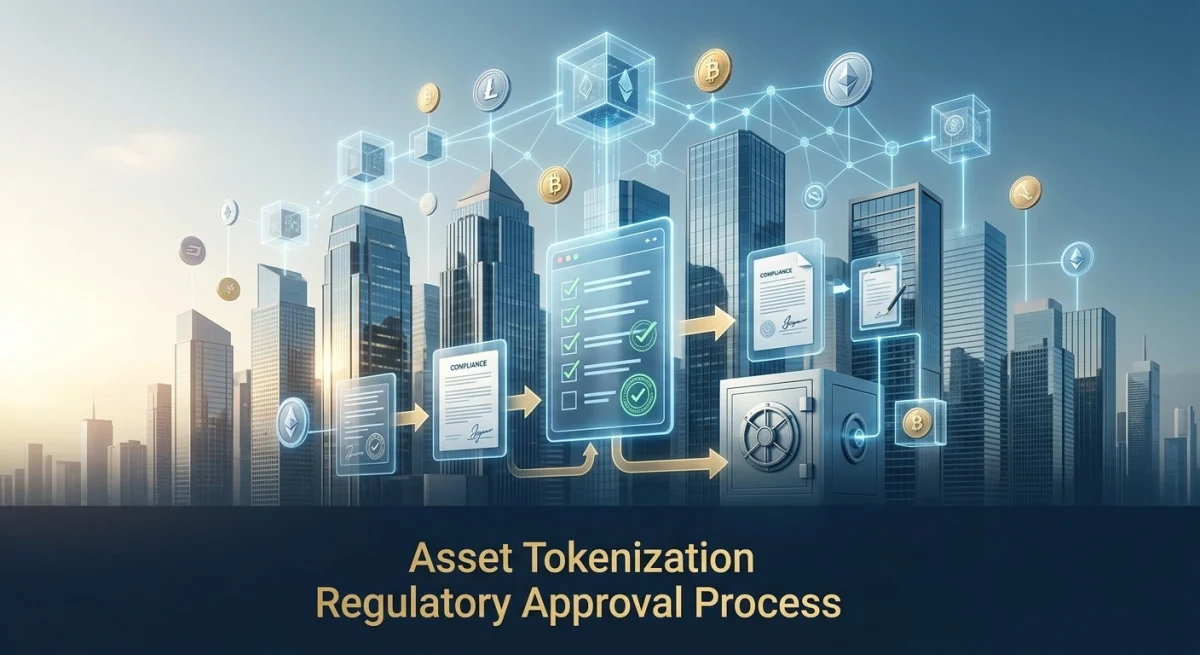
The Step-by-Step Setup Playbook
Phase 1: Pre-Flight (Weeks 1 to 6)
- Regulatory assessment. Engage a specialist legal team (Tokenova can help here) to map your token design, activity mix, and target customers to the optimal regulator.
- Jurisdiction selection. Typical founder heuristic: institutional and fund-heavy = ADGM; retail-facing crypto exchange = VARA; tokenized securities platform = DIFC or ADGM; mainland-first retail = CMA; asset-light startup = DMCC or RAK DAO.
- Corporate structure. A UAE holding company with regulated operating entities in one or two free zones is the standard. Budget AED 50k to 150k in legal for structuring.
Phase 2: Application (Months 2 to 8)
- Pre-application dialogue. ADGM and DFSA welcome pre-submission meetings; VARA requires the IDQ. Use them.
- Prepare the document pack. Business plan, AML/CFT manual, technology architecture document, fit-and-proper forms for every Responsible Individual, capital proof, and cybersecurity audit plan.
- Submit the application. Pay fees. Breathe. Answer follow-up queries crisply.
- Incorporate and lease office. Free zones typically allow flexi-desks; mainland requires physical office and an Emirati service agent.
Phase 3: Build (Months 4 to 10)
- Banking. Start early. Emirates NBD’s LivX, Mashreq, FAB, and ADCB all have crypto desks, but expect six to ten weeks even on a good day.
- Custody. Either deploy in-house multi-sig or HSM wallets (expect independent security audits) or partner with a regulated custodian. ADGM has institutional-grade options.
- AML/KYC stack. Implement blockchain analytics (Chainalysis, TRM, Elliptic) and travel rule tooling (Notabene, Sumsub). Hire a resident MLRO.
- Smart contract audit. Certik, OpenZeppelin, or Trail of Bits. Do not skip this even if the regulator does not ask for it yet.
- Legal opinion. A formal opinion classifying your token as security, utility, commodity, or hybrid. This will come up when banks onboard you.
Phase 4: Launch and Iterate (Months 8+)
- License granted. Clear final conditions; begin operations.
- Continuous compliance. Suspicious transaction reporting, periodic audits, annual renewals, and, if you are VARA-regulated, a new regulatory circular approximately every six weeks. Stay caffeinated.
Case Study: Tokenized Real Estate in Dubai
Tokenized Real Estate & Virtual Assets in Dubai | Paul Boots (VARA)
This is not theoretical anymore.
- March 2025: Dubai Land Department (DLD), in partnership with VARA, Dubai Future Foundation, and the Central Bank, launched the Real Estate Tokenisation Project pilot under the REES initiative. DLD became the first real estate registration authority in the Middle East to issue blockchain-based title deeds.
- May 2025: VARA formally recognized ARVAs in its Rulebook, giving tokenized real estate a proper home.
- February 20, 2026: Phase 2 launched, enabling secondary-market resale of approximately 7.8 million real estate tokens across 10 properties. Built on the XRP Ledger with Ripple Custody, through the Prypco Mint platform and infrastructure partner Ctrl Alt.
- Market projection: DLD forecasts tokenized real estate to reach AED 60 billion (USD 16 billion) by 2033, roughly 7% of Dubai’s total real estate transactions. Current tokenized real estate sector value in the UAE is around USD 1.2 billion.
- Minimum investment: AED 2,000. One villa valued at AED 1.75 million sold out in five minutes. A Dubai Hills project attracted 326 investors from 51 countries.
- Investor cap: No single investor can hold more than 20% of any tokenized property.
Stake RWA, another Dubai real estate platform, received in-principle approval from VARA in early 2026, suggesting the market is now opening beyond the initial pilot participants.
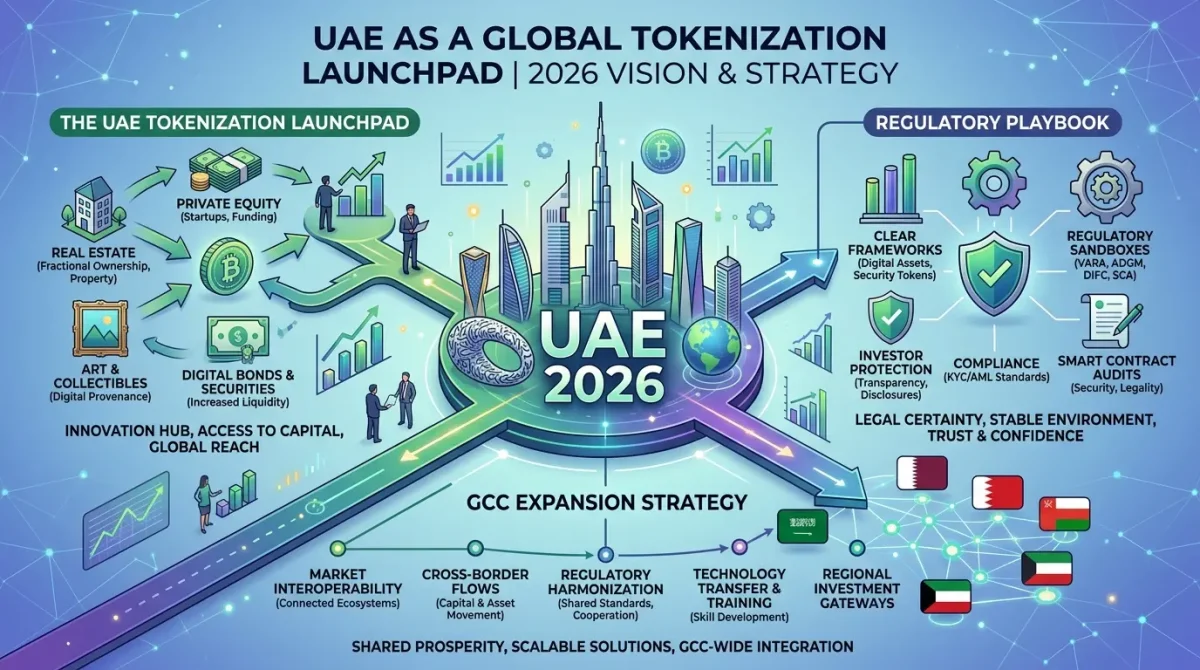
The GCC and MENA Expansion Strategy
Here is the uncomfortable truth that too many founders learn too late: there is no GCC crypto passport. Your UAE license does not auto-qualify you in Riyadh.
Country-by-country as of April 2026:
- Bahrain: The Central Bank of Bahrain (CBB) has the clearest framework in the region besides the UAE. Rain, CoinMENA, and similar exchanges hold CBB licenses. Security token offerings are possible under CBB’s crypto-asset module.
- Saudi Arabia: No specific crypto law yet. CMA (Saudi) and SAMA have run fintech sandboxes for tokenization. Retail crypto remains effectively unregulated; institutional activity is opening selectively.
- Oman: The Capital Market Authority of Oman has been developing a VA framework since 2023; sandbox activity is live. Watch this space.
- Qatar, Kuwait: Cautious to restrictive. Qatar Central Bank maintains a crypto ban for financial institutions.
- Egypt: Crypto activity is prohibited under banking regulations (Law 194/2020).
- Jordan: Central bank circular effectively restricts crypto for banks.
Smart expansion sequencing from a UAE base:
- Year 1: Launch in UAE (VARA or ADGM). Build traction with UAE residents and approved onshore investors.
- Year 2: Open a Bahrain arm under CBB for GCC-wide retail offering with different advertising rules.
- Year 3: Engage Saudi CMA and Oman CMA via sandbox participation.
- Year 3+: Passport-equivalent offering to accredited investors across MENA using ADGM / DIFC fund structures.
The August 2025 CMA-VARA cooperation agreement is worth tracking. It laid the groundwork for mutual recognition of VASP licenses inside the UAE. Full cross-emirate passporting has not materialized yet, but is on the public roadmap.
Common Pitfalls (Yes, We See These Monthly)
- Picking VARA when you needed DFSA. If your target customers are institutional investors putting in tokenized funds, DIFC with DFSA’s Investment Token regime is often cleaner than VARA.
- Applying before you have your MLRO. Regulators want to see a named, qualified, UAE-resident compliance officer. Recruit first.
- Ignoring the CMA overlay. Free-zone firms that market to UAE mainland clients need to think about CMA implications post-January 2026.
- Underestimating banking timelines. Your license will come; your bank account might not. Start banking conversations at week one, not month six.
- Treating ARVA real estate tokens like utility tokens. They are regulated financial products. Behave accordingly.
- Using marketing material that is not pre-approved. VARA and DFSA marketing rules are strict. Approvals take weeks.
Conclusion
The UAE did not stumble into being the world’s leading tokenization hub. It built the regulatory infrastructure deliberately, layer by layer, and then shipped real-world use cases (tokenized property title deeds, secondary-market resale, licensed global exchanges) before most jurisdictions finished their consultation papers. By April 2026, with the CMA restructure complete, the VARA Rulebook V2.0 in force, ARVA formally recognizing tokenized real assets, and the Digital Dirham pilot live, the UAE is not “ready for tokenization.” It is already executing at scale.
That does not mean launching here is simple. It means the opportunities are genuine and the bar is high. If you build right, choose the correct regulator for your specific activity mix, structure your token classification carefully, and invest in proper compliance from day one, the UAE is the most defensible launchpad for a global tokenization business in 2026 and the path to the full GCC and MENA.
That is exactly the work Tokenova does every day. If you are planning to structure, license, or expand a tokenized business in the UAE, talk to our team for a free jurisdictional assessment. We will tell you where you fit (and where you do not).
Frequently Asked Questions
Q1: Is Tokenova regulated in the UAE? Tokenova provides tokenization consultancy, token economics design, and jurisdictional structuring across DIFC, ADGM, and broader UAE free zones. We work alongside licensed custodians, broker-dealers, and legal partners to deliver end-to-end tokenization projects under VARA, FSRA, DFSA, and CMA frameworks.
Q2: What is the cheapest UAE license to start a tokenization platform? Bare-minimum total cost (including corporate setup, license, office, first-year compliance, and working capital) typically starts around USD 150,000 to 250,000 for a DMCC or RAK DAO setup limited to advisory and technology services. A full VARA exchange license, realistically, starts closer to AED 5 million to 8 million in total first-year exposure, including capital adequacy.
Q3: Is the SCA still a regulator in 2026? No. As of January 1, 2026, the Securities and Commodities Authority was reconstituted as the Capital Market Authority (CMA) under Federal Decree-Law 32 of 2025. All SCA rights, obligations, and existing licenses transferred to the CMA. Expect new implementing regulations throughout 2026.
Q4: Can foreigners invest in Dubai’s tokenized real estate? Currently the DLD pilot is limited to UAE ID holders (regardless of nationality), with broader international access in the roadmap. Accredited non-resident investor programs via ADGM or DIFC fund structures are already available as an alternative path.
Q5: Do I need a separate license for each virtual asset activity under VARA? Yes, typically. Each of the 7 VARA activities (Advisory, Broker-Dealer, Custody, Exchange, Lending, Management, Transfer and Settlement) requires its own authorization. Custody specifically must be a separate legal entity. Other activities can be aggregated under a single overarching license.
Q6: Is crypto mining actually legal in the UAE? Yes. Mining is legal and even encouraged in certain industrial zones, especially in Abu Dhabi. The caveats are zoning compliance, proper business licensing, and no use of subsidized agricultural electricity. Mining income is taxable under the 9% corporate tax and is not covered by the VAT exemption.
Q7: What is ARVA and why does it matter? ARVA stands for Asset-Referenced Virtual Asset, a VARA category introduced in May 2025 specifically for tokens backed by real-world assets like real estate, commodities, or income streams. ARVA is the legal wrapper that made Dubai’s tokenized real estate project possible at scale.
Q8: Do UAE residents pay tax on crypto gains? No personal income tax or capital gains tax applies to individual investors. Businesses trading crypto pay the standard 9% corporate tax on profits above AED 375,000, with possible free-zone exemptions.
Q9: How long does a VARA license really take in 2026? Realistically 6 to 9 months from first conversation to operational go-live, including incorporation, IDQ, ATI, full license, banking, and first audit. Founders who promise their investors a 3-month timeline are almost always wrong.
Q10: What is the single most important 2026 change I should know about? The CMA’s expanded federal perimeter over virtual assets and its extraterritorial reach. Even firms operating from free zones, and in some cases from abroad, may need to consider CMA compliance if they have a UAE nexus. This is the biggest structural shift the UAE regulatory regime has ever had.