
For decades, settling a cross-border tokenized asset against actual US dollars has required exactly the same thing as settling a fax against a fax: patience, correspondent banks, and a 9-to-5 mindset that the internet quietly mocked from a safer distance. On May 6, 2026, that finally broke. Ondo Finance, Kinexys by JPMorgan, Mastercard, and Ripple completed the first near real-time cross-border, cross-bank redemption of a tokenized US Treasury fund, settling the on-chain leg in under five seconds outside traditional banking hours.
If you only have one minute to read about RWA tokenization this week, read about this one. The infrastructure your future tokenized real estate, treasury, and trade finance products will run on just got its first real public test.
TL;DR
- What happened: Ripple redeemed Ondo Short-Term US Government Treasuries (OUSG) on the XRP Ledger. Mastercard’s Multi-Token Network (MTN) routed the fiat settlement instruction. Kinexys (JPMorgan’s blockchain platform) debited Ondo’s blockchain deposit account and wired US dollars to Ripple’s bank account in Singapore.
- The headline number: Asset leg processed on the XRP Ledger in under 5 seconds. The whole cross-border bank settlement happened outside traditional banking hours.
- Why this is a “first”: Previous tokenization pilots either kept everything on-chain or stopped at the blockchain boundary. This one fused public-chain execution with interbank settlement into a single coordinated flow.
- Market reaction: Ondo (ONDO) jumped from $0.27 to roughly $0.44 in seven days, a ~70% rally that erased its 2026 losses. XRP barely moved 1-2%, which is its own important signal.
- Why Tokenova readers should care: This is the prototype for how regulated tokenized assets in the UAE, GCC, and broader MEASA will eventually settle. Every UAE-based tokenization platform should be studying this transaction architecture.
What Actually Settled
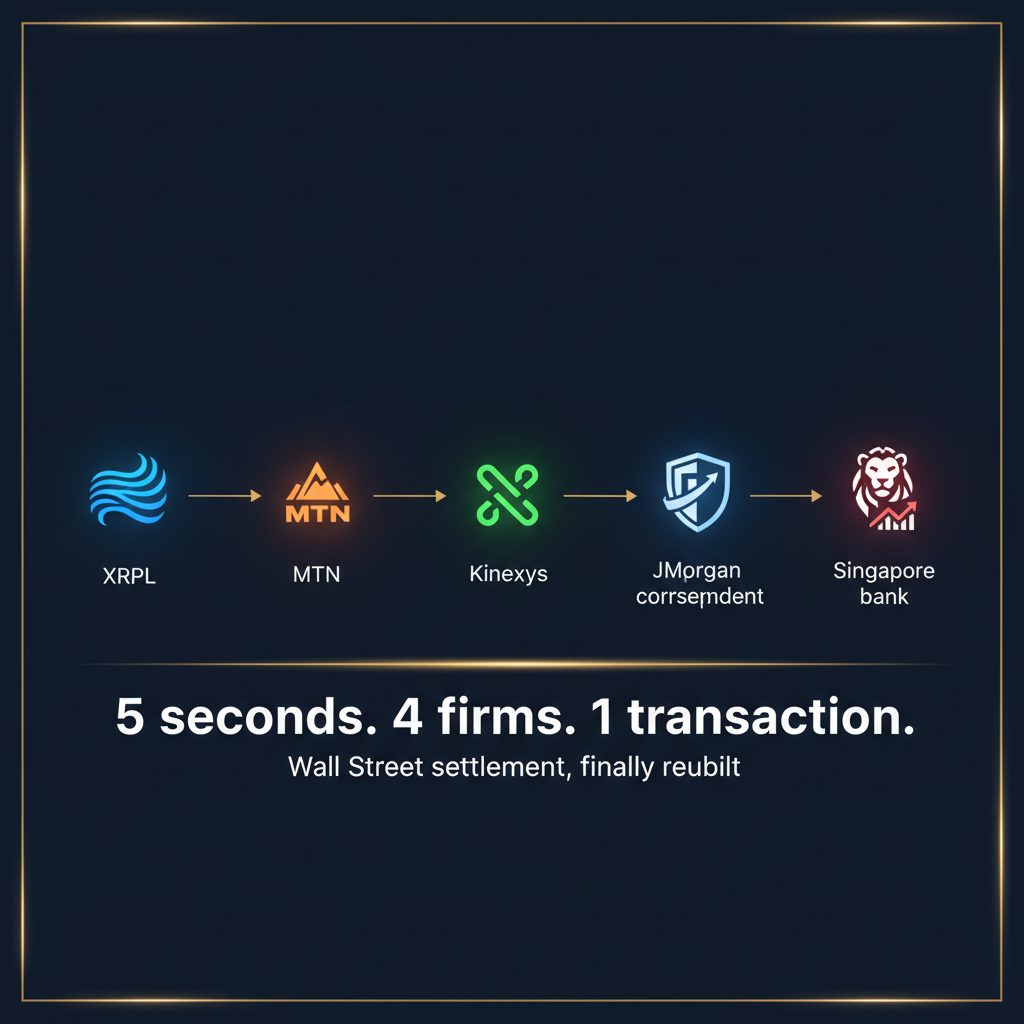
The transaction sounds simple, which is precisely why it took the four biggest names in cross-border money movement to make it work. Here is the actual flow, step by step:
- Ripple held tokenized OUSG on the XRP Ledger. OUSG is Ondo’s institutional-grade short-term US Treasury fund, built for accredited investors and qualified purchasers, and one of the largest tokenized Treasury products globally.
- Ripple initiated a redemption on the XRP Ledger. That leg cleared in under five seconds. The settlement asset for the on-chain leg was RLUSD, Ripple’s dollar-backed stablecoin, since OUSG has been built to use RLUSD as the settlement asset on XRPL since June 2025. XRP itself was used only to pay network fees.
- Ondo processed the redemption and triggered a fiat payout instruction.
- Mastercard’s Multi-Token Network routed the instruction to Kinexys by JPMorgan.
- Kinexys debited Ondo’s Blockchain Deposit Account at JPMorgan.
- JPMorgan’s correspondent banking network delivered the US dollars to Ripple’s Singapore bank account.
The whole thing happened as a single integrated flow rather than four sequential conversations between separate systems with mismatched calendars.
For context: a settlement of this type through traditional correspondent banking typically takes one to three business days. This took roughly the time it takes to read this paragraph aloud.
The Quotes That Matter
Ian De Bode, President of Ondo Finance, framed it cleanly: “This milestone represents the first time tokenized US Treasuries have settled across borders and banks in near real time and outside traditional banking windows. By connecting public blockchain infrastructure with interbank settlement rails, Ondo, Kinexys by JPMorgan, Mastercard, and Ripple are laying the groundwork for 24/7 global markets that never close.”
Markus Infanger, SVP of RippleX, leaned into the architecture: “The XRP Ledger enables real-time asset movement, and when paired with global banking infrastructure, this pilot shows how institutions can execute cross-border transactions as a single, integrated flow.”
Zack Chestnut, Global Head of Commercialization at Kinexys by JPMorgan, called it “an important step towards establishing a framework for institutional-scale tokenized asset markets.”
Translation from corporate-speak: this is the first time anyone has actually wired the on-chain world to the bank world without one waiting on the other.
Why This Pilot Was Possible (Spoiler: It Took a Decade of Plumbing)
The pilot is being framed as a sudden breakthrough, but it sits on top of years of unglamorous infrastructure work that finally clicked together this month:
- JPMorgan’s Kinexys platform has now processed over $3 trillion in cumulative transactions and was already running tokenized deposit volumes in the billions. In May 2025, Kinexys ran an earlier swap test with Chainlink and Ondo on the Ondo Chain testnet, but that was entirely on-chain. The May 2026 pilot was the first time Kinexys connected to a live public Layer 1.
- Mastercard’s MTN announced Ondo as its first tokenized RWA partner back in 2025. The May 2026 pilot used MTN as the routing layer between on-chain redemption and bank settlement.
- Ondo deployed OUSG on the XRP Ledger in June 2025, with RLUSD as the on-chain settlement asset.
- RLUSD is dollar-pegged, fully backed by US Treasuries and cash, and regulated under the New York Department of Financial Services. It is exactly the kind of stablecoin that passes institutional compliance.
In other words: the four firms did not magic this into existence in a weekend. They lined up four pieces of infrastructure that have been quietly maturing for two years, and then ran the first transaction that proved the seams hold under real load.
The Market Reaction Tells You Everything
ONDO (the Ondo Finance governance token) ran from $0.27 to $0.348 in the week around the announcement, a 29% gain, with a sharp 8% candle on confirmation. By May 9, the token was trading near $0.44, up roughly 70% over seven days, erasing all of its early-2026 losses.
XRP, by contrast, moved just 1-2% on the news. That muted reaction is the more interesting one, and it deserves explanation. Institutions use XRPL for the rails and settle in stablecoins. Société Générale’s euro stablecoin launched on XRPL earlier this year. SBI Holdings issued a $65 million tokenized bond on XRPL in 2025. Deutsche Bank integrated Ripple’s payment stack but said it would not use XRP directly. None of these moved XRP price meaningfully. The May 6 pilot followed the same pattern.
But XRPL’s institutional credibility just got a major upgrade. JPMorgan’s $3 trillion Kinexys platform now has a working integration with the XRP Ledger. Every other major bank evaluating XRPL just got a real reason to take it seriously.
The Bigger Picture: A $19 to $30 Billion Sector Just Got Its Settlement Layer
Total real-world assets on-chain hit $19 billion by late April 2026 (excluding stablecoins) and crossed $30 billion in tokenized assets including BlackRock’s latest filings during the week of May 5-10. Tokenized US Treasuries alone account for roughly $15 billion of outstanding value according to RWA.xyz, up from about $5 billion in late 2024.
Add this to the simultaneous May 2026 news:
- Bullish acquired Equiniti for $4.2 billion on May 5, picking up transfer-agent infrastructure for tokenized equities.
- DTCC will launch its tokenization service in October 2026, with Treasury bills and bonds among the eligible assets.
- BlackRock filed for two new tokenized vehicles on May 8, including an on-chain share class for its $7 billion Treasury liquidity fund.
- NYSE partnered with Securitize for a 24/7 tokenized securities platform in March.
- Nasdaq partnered with Kraken on a 24/7 tokenized stock trading plan.
Stack these together and the picture becomes obvious: 2026 is the year tokenized assets stopped being a side bet and became market infrastructure.
Why This Matters for the UAE and Tokenova Readers
Three reasons.
First, the architecture is portable. The pilot’s design (public blockchain + stablecoin settlement layer + interbank rails connector + bank correspondent network) is exactly the model that Dubai’s tokenized real estate market, ADGM’s tokenized fund issuances, and the broader UAE RWA economy will need to scale. Substituting AE Coin for RLUSD and an Emirates NBD or Mashreq leg for the JPMorgan correspondent banking piece, you have a near-perfect UAE adaptation.
Second, XRPL is already running Dubai’s tokenized property market. Dubai Land Department’s Phase 2 secondary market, which went live February 20, 2026, runs on the XRP Ledger using Ripple Custody and Ctrl Alt as infrastructure partners. The same XRPL credibility boost from the JPMorgan pilot benefits the UAE’s tokenized property strategy directly.
Third, this is what tokenized treasury operations look like for sovereign wealth funds. When ADIA, Mubadala, or PIF eventually move portions of their treasury onto regulated tokenization rails (and they will), the Ondo-JPMorgan-Mastercard-Ripple pilot is the working reference architecture. Tokenova clients building issuance platforms, custody solutions, or compliance infrastructure in the UAE should be reverse-engineering this transaction this week.
FAQ
Q: Was this a real transaction or just a sandbox test? This was a live pilot transaction involving a real OUSG redemption and real US dollars delivered to Ripple’s Singapore bank account. It was not a sandbox simulation. It was, however, a “controlled” transaction among named partners, not a general-availability product yet.
Q: How was the on-chain leg only five seconds when traditional settlement takes days? The XRP Ledger settles transactions in three to five seconds by design. The remaining work (Mastercard MTN routing, Kinexys debit, JPMorgan correspondent banking to Singapore) happened in parallel and outside traditional banking hours, which is the actual breakthrough.
Q: Does this make XRP a good investment? This article is not investment advice. XRP barely moved on the news, which suggests the market understands XRPL adoption does not require XRP price appreciation. The credibility boost for the XRP Ledger as institutional infrastructure is the real takeaway.
Q: What is OUSG? Ondo Short-Term US Government Treasuries. A tokenized fund holding short-term US Treasury securities, available to accredited investors and qualified purchasers. Currently around $287 million in on-chain market cap. Often described as Ondo’s institutional version of an on-chain Treasury bill fund.
Q: Is this available to retail investors? No. OUSG remains a qualified-access product. This pilot was an institutional cross-border redemption, not a consumer offering.
Q: When will this become a generally available product? The participants framed this as a pilot demonstrating a “framework” for institutional-scale tokenized asset markets. No general-availability date has been announced. Watch for follow-on transactions involving more banks, larger sizes, and other public blockchains.
Q: How does this affect the UAE tokenization ecosystem? Significantly. XRPL is already the infrastructure layer for Dubai Land Department’s tokenized real estate market. The Ondo-JPMorgan-Mastercard-Ripple pilot is portable architecture that UAE-based tokenization platforms, including those Tokenova structures, can adapt for AED-denominated tokenized assets settling through regulated UAE banking rails.
Conclusion
May 6, 2026 will probably show up in five years’ time as the moment tokenized fixed income stopped being a research project and became an executable financial product. Four firms, two public blockchains, one stablecoin, and a single five-second on-chain leg later, the world has a working reference architecture for 24/7 cross-border settlement of tokenized real-world assets. The next twelve months will be about whether that architecture scales beyond a controlled pilot. The next twelve weeks will be about how many other banks try to copy it.
Tokenova will be tracking every replication attempt. If you are building tokenized asset infrastructure in the UAE and want to understand how this architecture maps to your regulatory and banking environment, talk to our team.
Sources
- Ondo, Kinexys by J.P. Morgan, Mastercard, and Ripple Complete First Cross-Border, Cross-Bank Redemption of Tokenized U.S. Treasuries, PR Newswire, May 6, 2026.
- Ripple, JPMorgan settle first cross-border tokenized Treasury redemption on XRP Ledger, CoinDesk, May 7, 2026.
- XRP News: JPMorgan and Mastercard Settle Tokenized US Treasuries on XRP Ledger in 5 Seconds, 24/7 Wall Street, May 7, 2026.
- JPMorgan, Mastercard and Ripple complete cross-border XRP tokenized Treasury settlement, CryptoSlate, May 10, 2026.
Disclaimer: This article is editorial reporting for informational purposes only. It does not constitute investment, legal, or tax advice. Always conduct your own due diligence before engaging with any tokenized project or digital asset.