
Twelve days from kickoff, and the World Cup 2026 prediction markets have turned into one of the most interesting commercial fights in crypto. Not the tournament. The trading-on-the-tournament. Three platforms, three completely different bets on what a prediction market is supposed to be, and roughly half a billion dollars already wagered on who lifts the trophy at MetLife Stadium on July 19. ADI Predictstreet has FIFA’s blessing and Abu Dhabi’s money. Polymarket has the crypto-native crown and a fresh CFTC seal. Kalshi has the federal license, $11 billion valuation, and a CNBC ticker about to splash its odds across morning television.
Pick one and you are picking a worldview. Here is the honest, slightly opinionated breakdown of who is winning the World Cup 2026 prediction markets fight, where each platform actually shines, and why a quiet Abu Dhabi-shaped fingerprint sits underneath the official FIFA deal that nobody saw coming.
TL;DR
- ADI Predictstreet is the official FIFA prediction market partner (announced April 2, 2026). Gibraltar-licensed, technologically tied to Abu Dhabi-based ADI Chain, and a subsidiary of an IHC company. Big partnerships (DAZN, Fanatics Markets), but the live product still feels demo-shaped this close to kickoff.
- Polymarket is the crypto-native incumbent. $7.66 billion in January 2026 trading volume, now on Solana via Jupiter, recently CFTC-regulated in the US, $9 billion in international April volume against $1.3 billion in US volume.
- Kalshi is the regulated heavyweight. $9.16 billion in January, single-day record of $466 million on January 12, $11 billion valuation, available in all 50 US states via Coinbase, and a CNBC partnership that will put its tickers on Squawk Box.
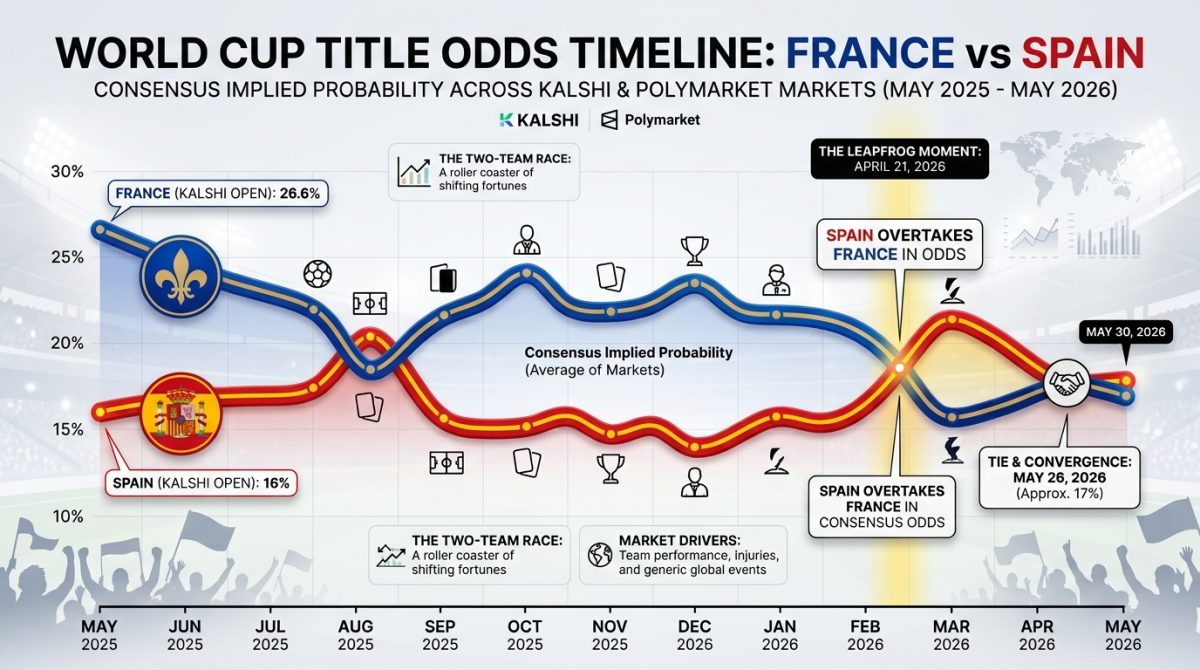
- France leads the title odds, with Spain right behind. The two tied at 17% on May 26.
- The aggregate World Cup winner contract has generated roughly $416.7 million across Kalshi and Polymarket so far.
- Tokenova readers: the ADI Predictstreet story is also a UAE Web3 story. The Abu Dhabi infrastructure underneath FIFA’s first-ever prediction market partner deserves more attention than it has been getting.
OK, Quick Refresher: What Is a Prediction Market?
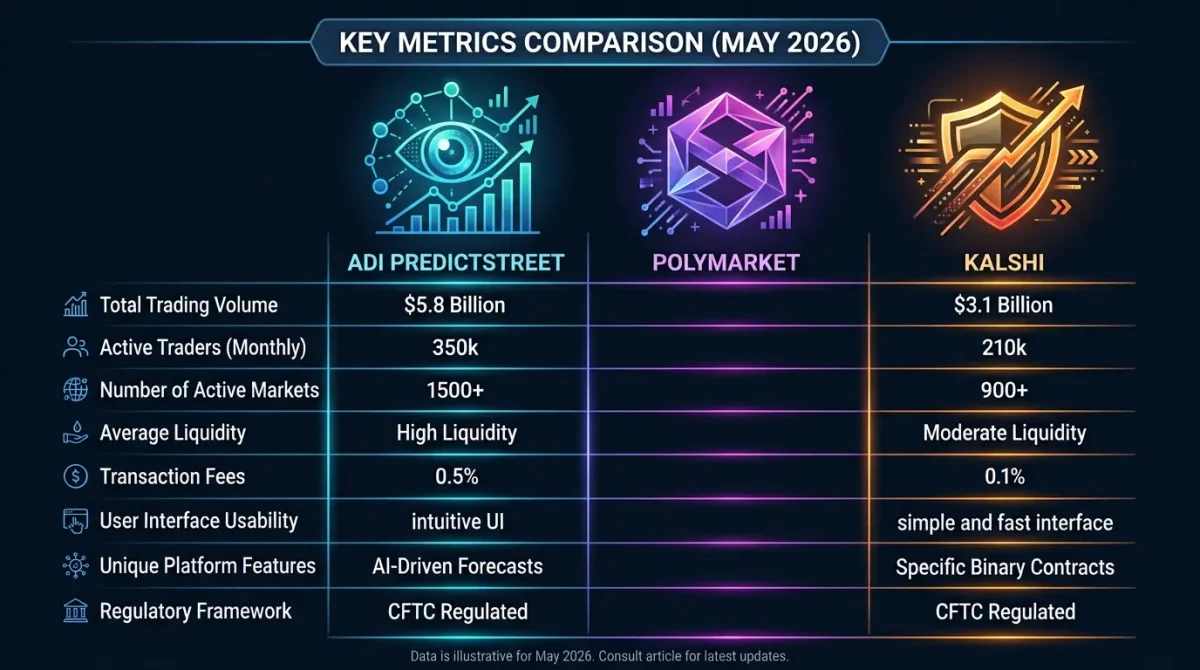
If you have not lived inside a Discord since 2024, here is the 30-second version.
How to use Prediction Markets Like Kalshi & PolyMarket (Easily Explained)
A prediction market is a marketplace where people buy and sell contracts on real-world outcomes. Each contract pays $1 if its outcome resolves Yes, $0 if it resolves No. The current price of a Yes share, like 18 cents, is the market’s implied probability that the thing happens. Eighteen cents equals 18%. Buy at 18, hope it resolves at 100, walk away with the difference. Lose the bet, lose what you paid.
What separates a prediction market from a sportsbook is the structure. A sportsbook is one house setting one line and skimming the vig. A prediction market is a peer-to-peer order book where the price is the consensus, you trade in and out before the event resolves, and the operator takes a much smaller cut. Translation: better odds, more efficient pricing, and the constant ability to flip your position when news drops mid-match.
That last bit is what makes them so dangerous on a World Cup. A team loses its starting goalkeeper to a calf strain at 4:14 pm? The price moves before the warm-up ends. You can sell out, you can double down, you can short the over. It is fast, it is live, and as of this month it is genuinely huge.
The Three Contenders
ADI Predictstreet: The FIFA-Branded Newcomer With an Abu Dhabi Backstory
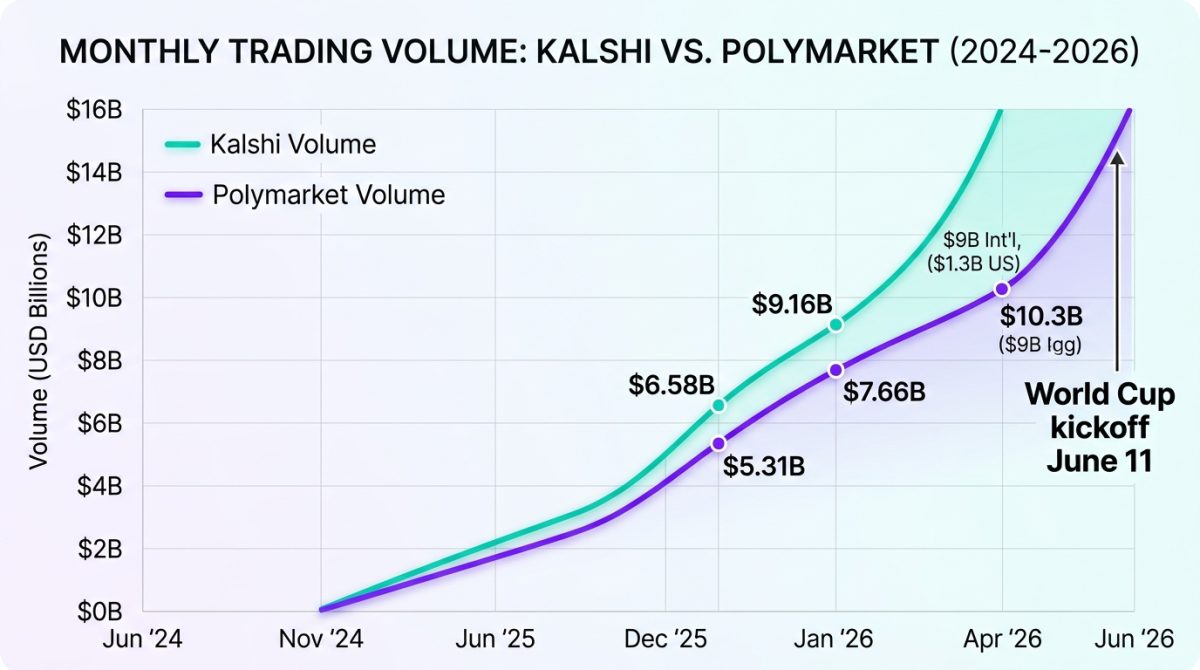
ADI Predictstreet wins the trophy for “platform you had probably not heard of two months ago that is suddenly on every Fan ID portal you visit.” It is, as of April 2, 2026, the first-ever Official Prediction Market Partner of the FIFA World Cup and the presenting partner of FIFA’s official free-to-play bracket challenge. That is a real commercial coup. It is also a deeply unusual one, because the platform itself is new.
Here is the structure most coverage glosses over. ADI Predictstreet is licensed and operating from Gibraltar, but the technology is tied to ADI Chain, an Abu Dhabi-based blockchain project founded by Sirius International Holding. ADI Predictstreet itself is a subsidiary of Finstreet Limited, which is a subsidiary of IHC (International Holding Company), one of the largest publicly listed companies in the UAE. So when FIFA announced its first-ever prediction market partner, it effectively announced an IHC-owned, Abu Dhabi-tech-backed, Gibraltar-licensed platform as its flagship category sponsor.
That is, to put it gently, not the boring crypto launch the press release made it sound like.
Since the FIFA announcement, ADI has stacked partnerships fast:
- April 14, 2026: Strategic partnership with DAZN to embed prediction markets directly into live stream viewing.
- May 28, 2026 (two days ago): Co-branded World Cup Hub with Fanatics Markets, the prediction subsidiary of Fanatics, two weeks before kickoff.
The numbers it actually trades, though? Public coverage has been polite about this. Reporting in late April still described the live ADI Predictstreet experience as “more like a free-to-play demo than a full real-money launch.” That gap between commercial muscle and product readiness is the thing to watch. FIFA’s branding will pull millions of fans through the door. Whether the product is ready to hold them is the bet.
Best for: Fans who want the official FIFA experience, free-to-play bracket competitors, and anyone who wants to follow the integration with DAZN broadcasts. The Abu Dhabi infrastructure story is also worth Tokenova readers’ attention as a case study in how UAE-rooted Web3 projects are landing global sports deals.
Polymarket: The Crypto-Native Heavyweight
If ADI is the new kid, Polymarket is the popular kid who already runs the school newspaper. It is the most recognizable crypto-native prediction market brand on the planet, and it walks into the World Cup with momentum that makes the rest of crypto look slow.
The numbers:
- $7.66 billion in trading volume in January 2026, up from $5.31 billion in December 2025.
- $9 billion in April 2026 volume on Polymarket International.
- $1.3 billion in April 2026 volume on Polymarket US, which is the newly CFTC-regulated American-facing version that launched after years of being functionally unavailable to US users without a VPN.
- Now integrated directly into Jupiter on Solana since February, which means anyone in the Solana ecosystem can take prediction market positions without leaving their wallet.
- Partnerships: DraftKings, PrizePicks, UFC parent TKO Group, and a CFTC-approved native token launch in preparation.
The character: Polymarket markets are crypto-native through and through. Sports is only 39% of total volume since July 2024 because politics, crypto, and weird-but-popular cultural bets (Chris Martin’s halftime show, anyone?) make up the rest. The platform speaks the language of meme-savvy traders, Gen Z attention spans, and on-chain transparency.
The World Cup setup: the title-winner market opened July 2, 2025. Spain led for most of the back half of 2025 and into early 2026 before France took over on April 21. The two have been within two percentage points of each other for over a month and tied at 17% on May 26.
Best for: Crypto-native traders who already live on-chain, anyone who wants the deepest range of side markets (player props, golden boot, halftime show futures), and US users who finally have a CFTC-blessed way in.
Kalshi: The Regulated Heavyweight That Beat Crypto at Its Own Game
Look, in a category that prides itself on being crypto’s answer to gambling, Kalshi is the one that actually feels like a bank. That is its superpower, not its weakness.
Kalshi is CFTC-regulated. It was federally licensed before its competitors. It is available in all 50 US states, including the ones that have spent the last decade fighting prediction markets in court, and Coinbase launched Kalshi-powered markets across all 50 states in January 2026 to lean into exactly that.
The numbers:
- $9.16 billion in trading volume in January 2026, up from $6.58 billion in December 2025. Higher than Polymarket.
- $466 million single-day volume on January 12, 2026, a 66.4% market share that day.
- $11 billion valuation.
- Multi-year CNBC partnership announced earlier this year, with Kalshi forecast tickers running on Squawk Box and Fast Money, plus a CNBC-branded page on Kalshi’s platform.
- Similar deal with CNN for on-air analysis.
The character: Kalshi is the sports-first platform. 80% of Kalshi’s trading volume is sports, compared to 39% on Polymarket. That is enormous for a World Cup cycle and explains why CNBC saw enough business case to plug Kalshi’s data into financial television.
The World Cup setup: Kalshi’s title-winner market opened May 2025, the earliest of the three. France held the early lead at 26.6%, dropped to 14% one day later, sat behind Spain until April 21, then leapfrogged to the front. Today France is the favorite, just barely. Same shape as Polymarket, slightly different prices on the deeper markets. Portugal, Argentina, the Netherlands, and Norway each show $90+ payout differences on a $100 risk between the two venues, which is the kind of arbitrage gap that exists exactly because liquidity is fragmenting across competing platforms.
Best for: US-based casual fans who want a regulated, mainstream-feeling, mobile-friendly experience. Sports specialists. And, frankly, anyone who saw what happened to other crypto products without a CFTC license and would rather not relive it.
The Numbers That Settle the “Who Is Winning” Argument
Strip away the marketing and look at the scoreboard.
| Metric | Kalshi | Polymarket | ADI Predictstreet |
| Jan 2026 monthly volume | $9.16B | $7.66B | Not disclosed |
| April 2026 monthly volume | Not disclosed | $9B (Intl) + $1.3B (US) | Not disclosed |
| Regulatory status (US) | CFTC-licensed, 50 states | Polymarket US CFTC-regulated | Not US-facing |
| Sports share of volume | 80% | 39% | 100% (sports-focused) |
| Headline valuation | $11B | Not disclosed | Subsidiary of IHC |
| World Cup title market open | May 2025 | July 2025 | TBD/limited |
| Big partnership stack | CNBC, CNN, Coinbase | DraftKings, PrizePicks, TKO, Jupiter | FIFA, DAZN, Fanatics Markets |
Headline take: Kalshi has the volume crown. Polymarket has the global reach and crypto-native depth. ADI Predictstreet has the only thing FIFA was willing to sell, and that is officialdom itself. The aggregate World Cup winner contract across Kalshi and Polymarket has already produced roughly $416.7 million in trading volume, and we are still 12 days from a ball being kicked.
The Current State of the World Cup Market (As of May 30, 2026)
Tournament markets right now look like this across both Kalshi and Polymarket:
- France: Slight favorite, around 17%.
- Spain: Tied or within a point of France at the top, around 17%.
- England: ~11.1% on Polymarket, ~11.2% on Kalshi. Thomas Tuchel’s bracket. Harry Kane’s tournament to deliver.
- Brazil: Top four.
- Germany: Right behind.
- Portugal: Cristiano Ronaldo’s last World Cup, priced as a real but outside chance.
- Argentina: Defending champion, Messi at 39, supporting cast still elite. Priced lower than fans want to admit.
- Netherlands, Norway: Honorable outside bets, with Norway making its first World Cup in 28 years.
The price discrepancies between Kalshi and Polymarket on Portugal, Argentina, the Netherlands, and Norway are the most interesting opportunity on the board if you are inclined toward cross-venue arbitrage. $90+ payout differences on a $100 risk position are not trivial.
One thing worth saying out loud: Italy did not qualify for this World Cup. They lost to Bosnia and Herzegovina on penalties on March 31. So Italy is not on the title boards. If you are looking for an Italy market, you will not find a meaningful one.
So Who Actually Wins This Fight?
Honestly? Probably all three. They are not competing for the same user.
ADI Predictstreet wins the moment FIFA’s free-to-play bracket goes live. Tens of millions of casual fans will touch the product because FIFA pushes it to them. That is a launch advantage no startup can buy. The question is whether ADI converts any of those casual users into real prediction market participants, or whether the FIFA deal turns into the most expensive free-to-play promotional campaign of all time. As of late May, the latter is uncomfortably plausible.
Polymarket wins the trader segment. Crypto-native users are not leaving Polymarket for an unregulated product or a CFTC-regulated competitor when they already have Polymarket on Solana, Polygon, and now a fully regulated US arm. The depth of side markets matters, and Polymarket has the deepest book.
Kalshi wins American mainstream. The CNBC ticker is going to drive more new prediction market users than every TikTok ad combined. When Joe Kernen reads a Kalshi probability on Squawk Box, the credibility transfer is enormous, and Kalshi is the only one of the three that can structurally accept that audience.
The real losers, if there are any, are sportsbooks. Traditional sportsbooks rely on opacity and house edge. Prediction markets are betting on the opposite proposition: transparency and peer-to-peer pricing. Every World Cup user who learns the difference is one fewer addressable user for DraftKings’s traditional book and one more for the alternative.
The UAE Web3 Lens
Because this is Tokenova, the Abu Dhabi backstory deserves an honest look.
ADI Predictstreet is not really a Gibraltar company in any meaningful sense beyond the operating license. The blockchain layer is ADI Chain, an Abu Dhabi-built infrastructure project from Sirius International Holding. The corporate parent chain runs through Finstreet Limited and back to IHC, which is one of the most acquisitive UAE conglomerates of the last decade. That this group landed FIFA’s first-ever prediction market category is a quiet but real signal: UAE-rooted Web3 projects are no longer just doing private sandbox launches. They are landing the most coveted global sports rights and pulling DAZN, Fanatics, and FIFA’s free-to-play tournament product into their orbit.
It is not the story most of the prediction-market press has told. It probably should be. The UAE’s regulatory clarity, capital depth, and willingness to underwrite consumer-facing Web3 plays is exactly the environment a project needed to be in a position to write the kind of cheque FIFA was willing to accept here. ADGM, VARA, DIFC, the CMA at federal level, the Central Bank for payment tokens, plus a tax environment that frees businesses to spend on global expansion. The infrastructure has been quietly built. ADI Predictstreet is the first really visible consumer test of what gets done with it.
Whether or not the platform performs operationally during the tournament, the structural lesson is the same. UAE Web3 has the capital and the licensing pathway to compete for global sports IP. We are going to see more deals like this, not fewer.
Day of the World Cup Market
The World Cup 2026 prediction markets are about to find out exactly how big they can get when the world’s most popular tournament collides with regulatory clarity, the most recognizable crypto brand, federal licensing, and FIFA’s commercial machine all at once. ADI Predictstreet has the official badge and the Abu Dhabi infrastructure behind it. Polymarket has the crypto-native depth and momentum. Kalshi has the volume crown and the mainstream credibility play. Twelve days from now, we are going to learn which of those things actually matters when 48 teams and 104 matches start producing data.
What we already know is that prediction markets are no longer the niche they were at Qatar 2022. The aggregate volume on the title contract alone (~$416.7 million) is roughly five times the entire prediction market sector’s quarterly volume in 2022. Whatever happens during the tournament, this category has graduated.
Tokenova will be tracking the operational performance, the regulatory ripple effects, and the UAE Web3 angle on ADI Predictstreet throughout the tournament. If you are building a tokenized sports, gaming, or fan-engagement product and want to understand the regulatory and structural landscape in the UAE and broader GCC, talk to our team.
FAQ
Q: Which World Cup 2026 prediction markets are actually available to US users? Kalshi (CFTC-licensed in all 50 US states), Polymarket US (newly CFTC-regulated). Polymarket International is not formally available to US users without a VPN. ADI Predictstreet does not currently target US users.
Q: Is ADI Predictstreet a UAE company? Its corporate parent runs through IHC, a major UAE-based conglomerate. The blockchain infrastructure (ADI Chain) is Abu Dhabi-based. The operating license is in Gibraltar. So functionally, yes, there is a substantial UAE story underneath ADI Predictstreet, even though the customer-facing entity is Gibraltar-based.
Q: Why is Kalshi’s volume higher than Polymarket’s if Polymarket is more famous? Two reasons. First, Kalshi has been CFTC-licensed and US-available longer, so it captures US sports volume that Polymarket International cannot. Second, Kalshi is sports-first (80% of volume) versus Polymarket’s more diversified mix (39% sports). A World Cup year naturally favors the sports-heavy platform.
Q: What is the difference between Polymarket and Polymarket US? Polymarket International (often just called Polymarket) is the original crypto-native platform that has historically not been formally available to US users. Polymarket US is the newer, CFTC-regulated entity launched specifically for the American market. They share branding but operate under different regulatory regimes.
Q: Are prediction markets legal in my country? That depends on where you live and is rapidly changing. As a general rule: in the US, Kalshi and Polymarket US are federally regulated. Outside the US, regulations vary wildly. This article is not legal advice. Check your local rules before participating.
Q: Can prediction markets actually predict outcomes better than bookmakers? On average, yes, especially for events that have a long lead time, deep liquidity, and broad public interest. Markets that aggregate real money positions tend to settle closer to true implied probability than house-priced sportsbook lines, which carry margin and react more slowly. For obscure events with thin liquidity, sportsbook lines can be competitive or better.
Q: What is the biggest single market on the World Cup right now? The aggregate “FIFA World Cup 2026 Winner” contract across Kalshi and Polymarket has generated approximately $416.7 million in trading volume, settling July 20, 2026, the day after the final.
Q: How do prediction markets make money if they do not take house edge? They charge trading fees, typically much lower than a sportsbook’s vig. Kalshi charges per-trade fees. Polymarket has gas costs (and a planned native token) plus optional fees. Operators also profit from liquidity provision and market-making across their order books.