
The Gulf used to export barrels. Now it exports blockspace. In roughly eighteen months, the GCC has gone from “pilot phase” to “publishing operating manuals,” and the numbers have kept pace. Kearney and Ctrl Alt peg the regional opportunity at close to half a trillion dollars by 2030, and the global RWA market just crossed $24 billion in February with private credit and tokenized Treasuries doing most of the heavy lifting. Dubai’s Phase II secondary market for tokenized property deeds opened on 20 February 2026. The IMF, in an unusually direct note on 2 April 2026, called tokenization a structural reconfiguration of finance, not a tech fad.
If you are an asset manager, family office, SWF allocator, or founder staring at an ADGM SPV diagram wondering where to start, this is your map.
1. Why the Gulf and Why Now 
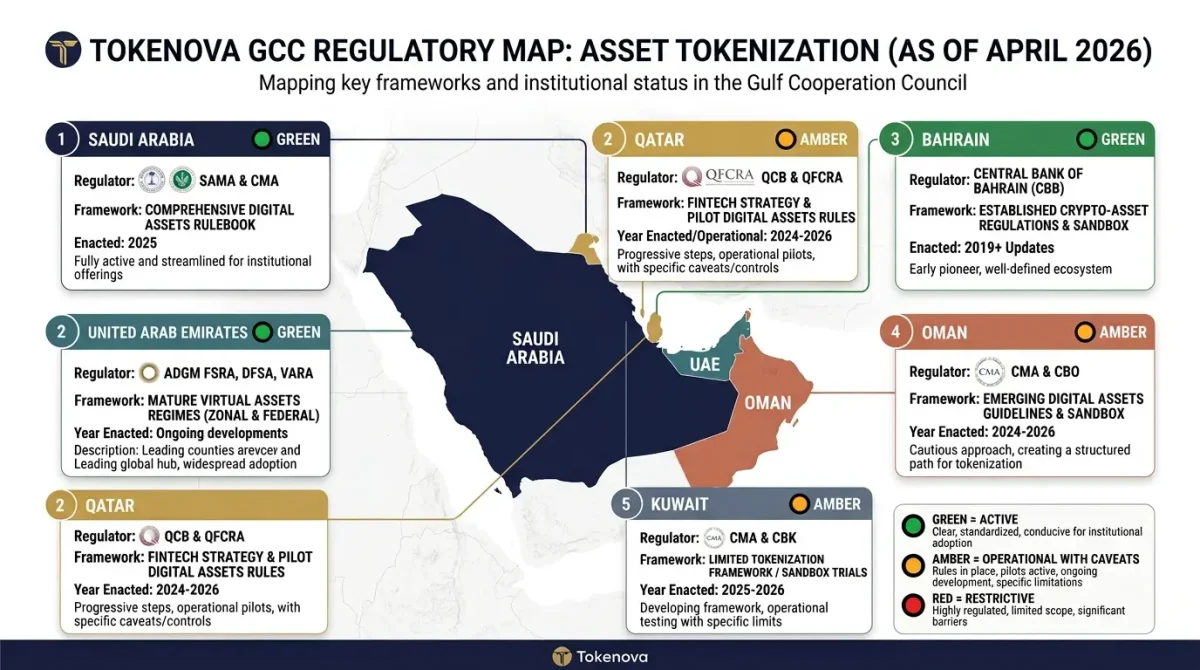
Three forces collided. First, regulators stopped being shy. VARA, DFSA, ADGM FSRA, the CBB, and the QFCRA have all published token-specific rulebooks, and as of January 2026, DFSA’s Crypto Token Regime is fully operational.
Finance Pulse: Microsoft, US-South Korea Trade, Dubai Blockchain & Powell’s Fed Signal
Second, the capital is local. Gulf SWFs and family offices sit on trillions in dry powder actively hunting yield and diversification, and tokenized rails let them slice previously chunky assets into globally distributable tranches. Third, the infrastructure caught up: the UAE’s dirham-backed DDSC stablecoin went live in February 2026, the Digital Dirham pilots are rolling, and Saudi Arabia’s Real Estate Registry (REGA) now maintains property rights natively on-chain.
Stablecoins proved the rails. Real-world assets are filling the trains.
Here are some key 2026 data points to anchor the conversation:
- $500 billion: projected addressable GCC tokenization market by 2030 (Kearney / Ctrl Alt).
- $16 billion: Dubai Land Department’s tokenization target by 2033 (7% of the market).
- $24 billion+: global tokenized RWA value as of February 2026, growing 266% in 2025.
- 710,792: global on-chain RWA holders as of 6 April 2026, up 5.56% in thirty days.
- 0%: VAT now charged on virtual-asset transfers and custody in the UAE (exemption effective 15 November 2024).
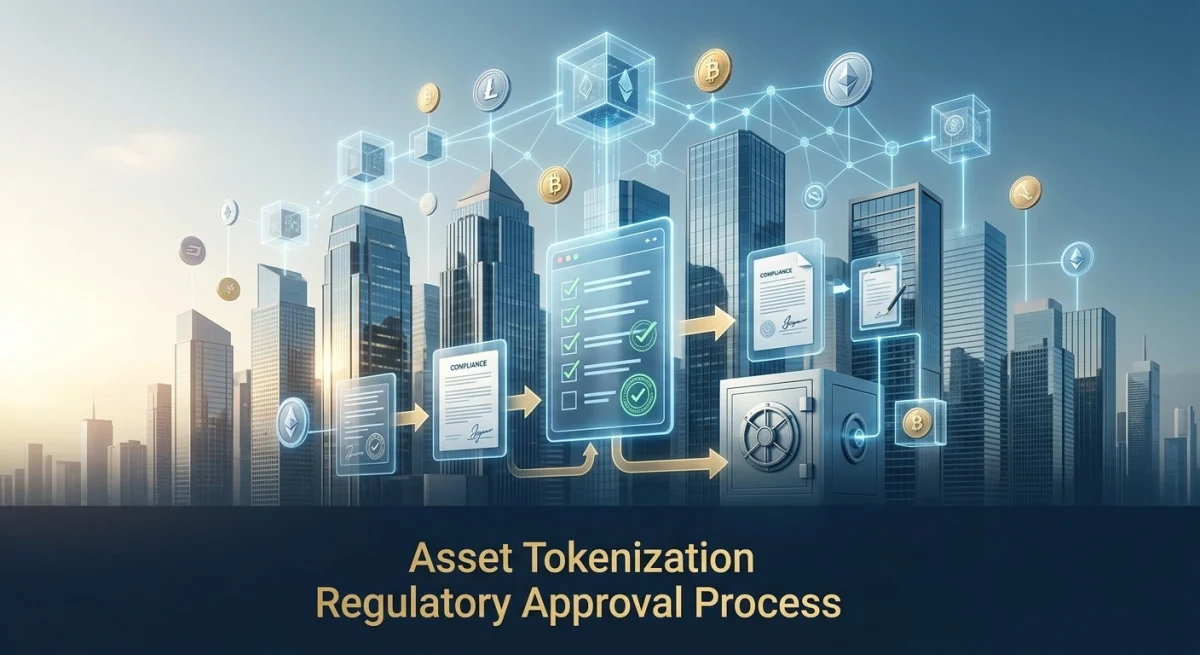
2. The Regulatory Map, Jurisdiction by Jurisdiction
A quick tour of who regulates what, because confusing VARA with the SCA is a fast route to an expensive legal bill.
United Arab Emirates (Federal)
The UAE runs a layered model. The Securities and Commodities Authority (SCA) handles token activity onshore, the Central Bank (CBUAE) supervises payment tokens and AML, and the Virtual Assets Council coordinates between Dubai’s VARA, Abu Dhabi’s FSRA, and DIFC’s DFSA. April 2026 brought the SCA’s updated Virtual Assets Regulations, giving issuers a cleaner federal rulebook for general VA activities, conduct, trading, AML, and prudential standards. Stablecoins, security tokens, and NFTs are all addressable here, and the November 2024 VAT amendment exempts most crypto transfers, custody, and conversion from the 5% VAT.
Dubai (VARA and DIFC)
VARA governs virtual-asset activity in Dubai (outside DIFC) under Law No. 4 of 2022. Licensed categories cover exchanges, custodians, brokers, issuers, and stablecoin providers. Privacy coins and algorithmic stablecoins are prohibited, full stop. In DIFC, the DFSA’s Crypto Token Regime became effective on 12 January 2026, adding a recognized-token list, funds regime, and tighter suitability rules. Think of DIFC as where institutional token funds incorporate, and VARA as where Dubai’s consumer-facing tokenization platforms actually operate.
Abu Dhabi (ADGM FSRA)
ADGM published the region’s first serious digital-securities framework back in 2020 and upgraded it in June 2025. It covers tokenized funds, bonds, and derivatives under its FSMR regime. ADX listed the region’s first DLT-native bond in July 2025 through HSBC’s Orion platform with settlement linking into Euroclear and Clearstream. Translation: global institutions can now buy a Gulf-issued digital bond through their existing settlement pipes.
Saudi Arabia (CMA and SAMA)
Saudi has taken a slower, infrastructure-first approach. There is no standalone “crypto law,” but the CMA’s Tokenization Sandbox and the Real Estate General Authority’s (REGA) blockchain property registry went operational in June 2025, with the first blockchain-backed deed transfer completing in early 2026. Tokens representing profit-sharing or ownership get slotted into existing securities law. Expect broader rules in late 2026 as the foreign-ownership reforms open up the property market.
Qatar (QFC)
The QFC’s Digital Assets Framework and Investment Token Rules (September 2024) define a category called “Permitted Tokens” backed by real-world assets or utility. Pure crypto and algorithmic stablecoins sit outside the perimeter. Token issuers pre-validate their token design with the regulator, which is slower but produces rock-solid compliance. Qatar has leaned into Shariah-compliant sukuk tokenization, including an Al Rayan Bank proof-of-concept on Hashgraph in late 2025.
Bahrain (CBB)
The CBB’s Crypto-Assets Module (CRA), first issued in 2019 and updated in 2023, is among the most mature retail-and-institutional hybrid frameworks in the region. ATME, a CBB-licensed exchange, issued its first 1 kg gold-backed token in March 2025 and has been methodically adding tokenized RWAs since. Bahrain is also co-sponsoring the Gulf’s first oil-backed stablecoin (OIL1) expected in 2026.
Oman
The CMA announced a virtual-assets framework in February 2023 and is working with XReg and SASLO to finalize it. Nothing is live yet, but expect AML-first licensing modeled on FATF recommendations.
Kuwait
The odd one out. CBK and CMA circulars from 2023 and 2024 impose a near-absolute prohibition on virtual currencies. Firms cannot deal, advise, or facilitate. If you are structuring for Kuwait, the answer is “not in Kuwait.”
3. Flagship Pilots You Should Actually Study
Dubai Land Department x Prypco x Ctrl Alt
Started as a sandbox in March 2025, commercial platform live May 2025, and Phase II (secondary market) opened on 20 February 2026. About 7.8 million tokens tied to ten Dubai properties, $5 million in initial tokenized assets, XRP Ledger rails, Ripple Custody, Zand Bank as fiat custodian, and trades recorded directly against the DLD land registry. The target remains $16 billion tokenized by 2033.
ADX and First Abu Dhabi Bank Digital Bond
Listed July 2025. A USD-denominated corporate bond issued natively on HSBC Orion (permissioned DLT) and cleared through Hong Kong’s CMU with linkages to Euroclear and Clearstream. Quietly one of the most replicable models for Gulf debt capital markets.
Mubadala x Kaio
Announced December 2025. Kaio’s permissioned institutional tokenization platform is wrapping roughly $500 million of illiquid Mubadala private-fund AUM into security tokens. This is where the “tokenized private equity” thesis stops being theoretical.
Realize x Neovision Tokenized T-Bills Fund
A $200 million target fund issuing $RBILL tokens on Ethereum and IOTA, backed by US Treasury ETFs held by the fund. An ADGM-linked structure aimed at giving Gulf investors dollar-yield exposure in a programmable wrapper.
ATME Gold (Bahrain)
One kilogram physical gold bars tokenized on a CBB-licensed exchange, sold out within days in March 2025. Small in absolute terms, but a clean proof that the custody-plus-token model works for commodities.
REGA National Property Tokenization (Saudi)
Infrastructure-level rather than consumer-level. The national registry maintains the on-chain record, SPVs hold legal deeds, and platforms plug into the registry. Expect this to be a default model for Vision 2030 giga-project financing.
QFC Digital Sukuk
AAOIFI-aligned governance, Hashgraph-based settlement in the Al Rayan Bank PoC, launched October 2025. If you care about Islamic finance, watch this one like a hawk.
4. The Technical Stack: Chains, Standards, Stablecoins
Most institutional projects split along a predictable line. Public Ethereum (and increasingly XRP Ledger, IOTA, and Polygon) for assets with global distribution and secondary-market ambition. Permissioned consortium chains such as HSBC Orion and Kaio’s private ledger for assets where counterparty whitelisting matters more than open composability.
Standards you will see a lot of in 2026:
- ERC-3643 (T-REX): the de facto institutional standard for permissioned security tokens, now dominant in Gulf fund tokenization.
- ERC-20 for stablecoins and fungible utility tokens.
- XRP Ledger with ARVA overlay: Dubai’s Asset-Referenced Virtual Asset classification sits on top of the ledger to enforce eligibility and compliance logic at the token layer.
- ADI Chain: UAE’s sovereign Layer-2 that hosts the DDSC dirham stablecoin.
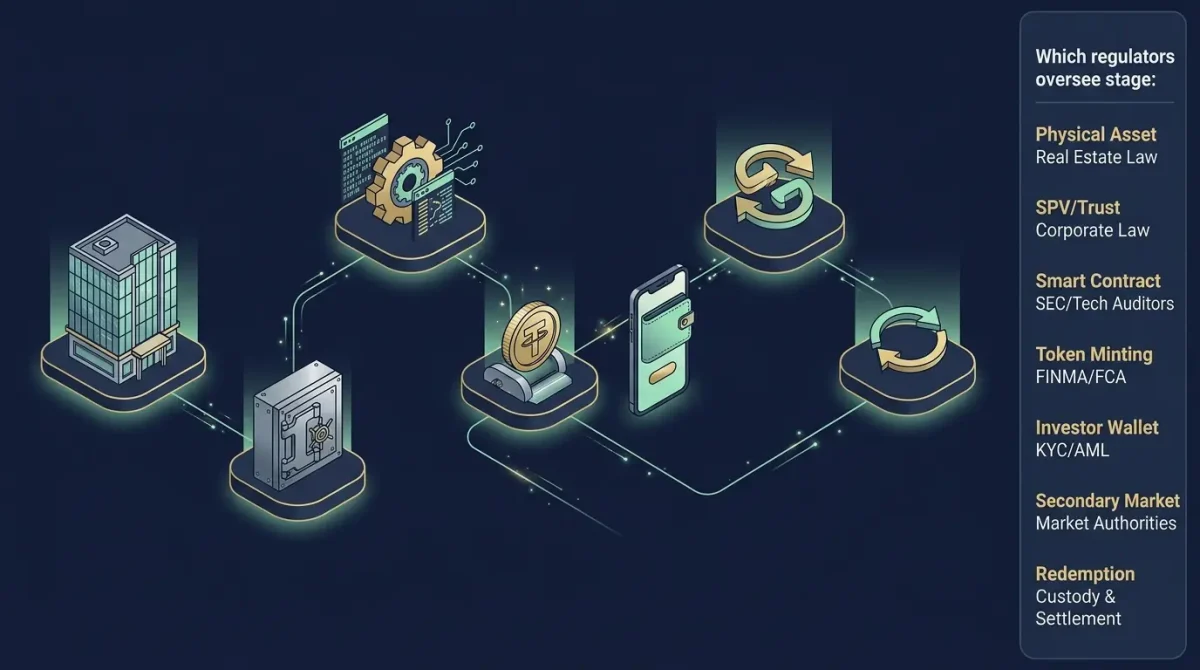
The pattern is consistent. Legal ownership lives off-chain in an SPV or trust. The smart contract is a programmable registry, not a title deed. Tokens carry economic and sometimes voting rights; custody of the underlying asset stays with a licensed entity. Settlement happens in a regulated stablecoin (DDSC, AE Coin) or, for cross-border debt, through hybrid DLT-to-CSD bridges.
5. Custody, Settlement, and the Boring Plumbing That Matters
There are two custody models that dominate:
Institutional custody. A licensed bank or qualified custodian holds either the underlying asset, the fiat backing, or the investors’ token wallets. Zand Bank handled fiat custody for the DLD pilot. Ripple Custody secures the XRPL side. Al Salam Bank and BBK hold client fiat for ATME in Bahrain. This is what most regulated offerings use because it maps cleanly onto existing banking supervision.
Self-custody. Allowed in some Gulf frameworks (ATME explicitly permits it), generally reserved for sophisticated investors who understand key management. Self-custody reduces counterparty risk but introduces operational risk that most institutional allocators will not underwrite.
Settlement is increasingly T+0. The XRP Ledger settles in three to five seconds. ADI Chain and HSBC Orion settle in seconds for permissioned transfers. The catch: cross-border settlement still often needs an off-chain mirror because your counterparty’s CSD does not speak to your blockchain. The ADX/FAB bond solved this by writing the bond natively on-chain and using CMU-Euroclear-Clearstream as the bridge into traditional settlement. More Gulf issuers will copy that pattern.
6. AML/KYC and the Compliance Layer
Every GCC token regime is FATF-aligned. The tooling has matured fast:
- Reusable KYC credentials (soulbound ID passports, zero-knowledge proofs) are replacing re-verification per offering. Verify once, participate everywhere.
- On-chain transfer restrictions via ERC-3643 enforce investor eligibility at the token level, not just at the platform level.
- Transaction monitoring integrates Chainalysis, Elliptic, and TRM Labs at the exchange and custodian layer.
- Privacy coins and algorithmic stablecoins are prohibited in ADGM, VARA, and QFC. Do not bother trying.
Retail access is narrower than marketing copy suggests. Most Gulf token offerings are still restricted to accredited, institutional, or residency-verified investors (the DLD pilot is UAE-ID-only during Phase I and II). Expect broader retail access in late 2026 and 2027 as distribution platforms get licensed.
7. Tax Treatment: The UAE Quietly Made Life Easier
On 15 November 2024 the UAE amended its VAT law to exempt most virtual-asset transactions from the 5% tax. That includes the sale, transfer, conversion, and custody of crypto and tokenized assets. Fund management services involving virtual assets also fall under the exemption. The change is retroactive to 1 January 2018, which means refunds are on the table for historical activity.
Saudi, Bahrain, Oman, and Qatar have not yet mirrored this specifically. Standard GCC VAT rules (5%) apply, with no crypto carve-out yet. Corporate income tax in the UAE (9% on profits above AED 375,000) applies to token-issuing entities, with typical exemptions for DIFC and ADGM qualifying activities. Individual capital gains tax remains zero across most of the GCC, which is one reason family offices are such enthusiastic participants.
Cross-border tax treatment is still jurisdiction-specific. An ADGM SPV distributing tokenized fund yield to a European institutional investor triggers a very different analysis than the same structure paying a GCC family office. Get tax counsel early. Tokenova can help you map this before you incorporate.
8. Risks That Keep Compliance Officers Up at Night
Let us be honest about the list:
Legal enforceability. A token is a ledger entry; a court order is what actually moves the asset. Gulf regulators handle this by requiring an onshore SPV that holds legal title and issues tokens as registered securities. Good practice, but cross-border enforcement (token holder in Jakarta, asset in Riyadh) is still jurisdiction-by-jurisdiction.
Liquidity. Most tokenized RWAs still trade thinly. A 2025 arXiv study found most RWA tokens exhibit low volumes, long holding periods, and limited investor participation. Even the DLD Phase II secondary market started with a controlled pilot rather than open trading. Liquidity does not emerge automatically; it needs market-makers, distribution partnerships, and, ideally, DeFi collateral use.
Smart-contract risk. Bugs, exploits, oracle manipulation. ERC-3643 and audited templates from firms like Tokeny and Fireblocks reduce but do not eliminate this. Assume a security audit line item on every budget.
Cybersecurity and quantum. Not quite hypothetical anymore. Post-quantum cryptography upgrades are on the roadmap for several GCC infrastructure players. If your token plans to exist in ten years, ask about the upgrade path today.
Shariah compliance. Matters more in this region than anywhere else. Scholars want to see asset-backing, absence of gharar (excessive uncertainty), and halal revenue streams. QFC’s token framework explicitly cross-references AAOIFI standards.
9. Demand Signals: Who Is Actually Buying
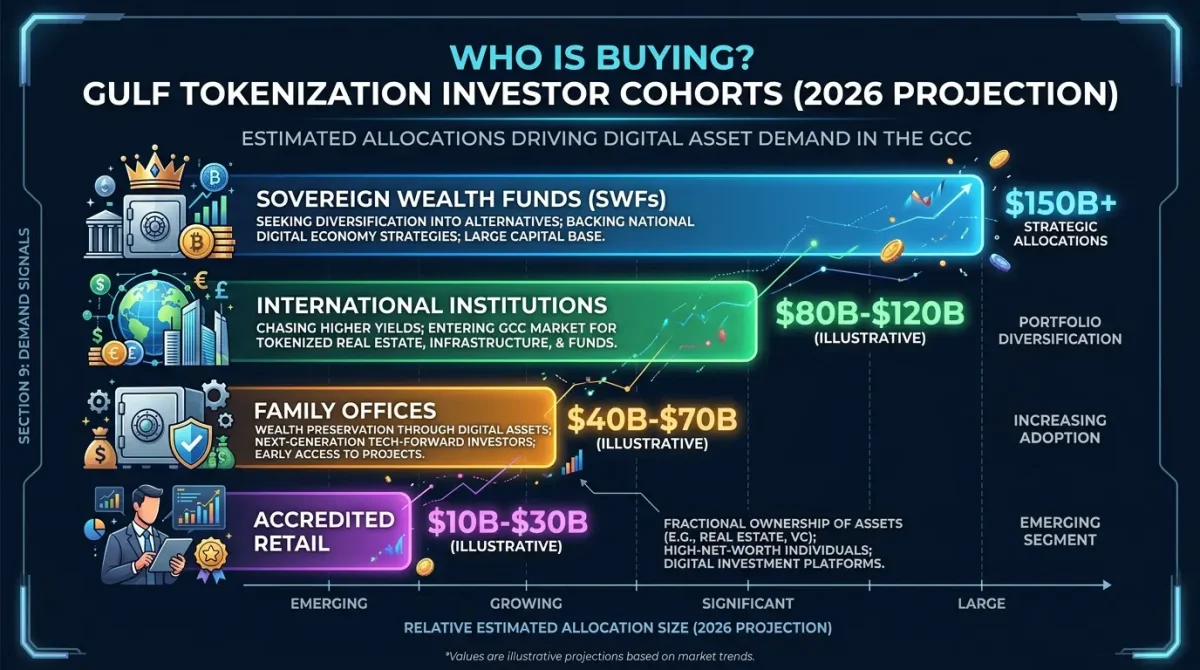
Four investor cohorts dominate Gulf token offerings in 2026:
- GCC family offices. The single-biggest buyer cohort for real estate and PE tokens. They want Shariah-compliant, dirham-settled, and preferably DIFC or ADGM domiciled.
- Sovereign wealth funds. Allocating small but real check sizes into tokenized infrastructure and private credit. Mubadala’s Kaio partnership is the template.
- International institutions. BlackRock, Franklin Templeton, HSBC, BNP, and Apex Group (via Tokeny) have all set up Gulf-facing operations or partnerships. The ADX/FAB bond opened the door; everyone else is walking through it.
- Accredited retail. Dubai residents snapped up DLD pilot tokens in under two minutes per offering. Demand is real and substantially exceeds current supply.
Asset classes getting the most interest: real estate (both Dubai and Riyadh), gold and other commodities, tokenized sukuk, private credit, short-duration Treasury products, and carbon credits (an increasingly active category following COP28’s Dubai legacy).
10. Governance: Where Shariah Meets Smart Contracts
The default Gulf governance pattern is a dual layer. Off-chain, an SPV or fund vehicle holds assets under local corporate and securities law. Its board and, where relevant, Shariah supervisory committee make the real governance decisions. On-chain, smart contracts execute the consequences: dividend distributions, transfer restrictions, redemption mechanics, voting records.
This is not a workaround; it is the regime working as designed. Tokens give you speed and transparency. The legal structure gives you enforceability. Merging them well is what separates a serious tokenization consultancy from a pitch deck.
11. The Road to 2030
A few things look increasingly predictable:
- UAE CBDC + stablecoin rails will dominate settlement by 2028. DDSC, AE Coin, and the Digital Dirham are already operational or in pilot. Expect them to be the default settlement layer for Gulf token markets.
- Saudi Arabia’s national infrastructure approach will scale faster than skeptics expect. Once REGA integrates with the NEOM-linked energy tokenization pilots, the model becomes template-ready for sukuk and infrastructure finance.
- Bahrain and Qatar will specialize. Bahrain as the retail-and-commodities sandbox, Qatar as the Islamic-finance-native digital market.
- Oman will publish its framework in 2026 or early 2027.
- Kuwait will remain the regional holdout unless political winds change.
Kearney’s $500 billion number is ambitious but no longer ridiculous. Getting there requires solving the liquidity problem, not the technology problem. That is a distribution, market-making, and interoperability challenge, and it is where the next generation of Gulf tokenization platforms will earn their valuations.
Conclusion
The Gulf got tokenization right by doing the unglamorous work first. Regulators wrote rulebooks before writing press releases. Custodians got licensed before platforms went live. SPV structures were mapped to Shariah and common-law frameworks before the first token was minted. The result is a region where “compliant tokenization” is not an oxymoron; it is a competitive advantage.
For institutions still sitting on the sidelines, the question is no longer whether the infrastructure is ready. It is. The question is which asset to bring on-chain first, which jurisdiction to domicile in, and which partners will help you navigate the legal-technical-operational triangle without collapsing any of its three sides.
That last bit is where Tokenova lives. If you are thinking about tokenizing a fund, a real-estate portfolio, a sukuk issuance, or anything in between, we help you find the right jurisdiction, structure the right SPV, deploy the right smart contracts, and stay on the right side of every regulator from VARA to QFCRA. The half-trillion-dollar opportunity will go to the teams who start building now, not the ones still debating whether blockchain is “ready.”
It is. You can.
Talk to Tokenova about your tokenization strategy →
FAQ
Is tokenizing real estate legal in Dubai?
Yes. The Dubai Land Department, VARA, and the Central Bank of the UAE jointly authorized the Real Estate Tokenisation Project. Phase II, enabling secondary-market resale, launched on 20 February 2026. Tokens are recorded against official title deeds on the XRP Ledger and paired with ARVA compliance overlays.
What is the minimum investment for tokenized Gulf real estate?
The DLD pilot opened at AED 2,000 (approximately $545) per token. Most institutional PE and private-credit token offerings have much higher minimums, typically $10,000 to $100,000, depending on investor accreditation.
Which is better for a tokenized fund: DIFC, ADGM, or VARA?
It depends on the asset. ADGM is strongest for tokenized bonds, derivatives, and institutional funds. DIFC shines for crypto-adjacent funds under its updated 2026 regime. VARA is where you want to be for consumer-facing exchanges, stablecoins, and real-estate platforms operating inside Dubai emirate. A good consultancy maps the asset to the regime, not the other way around.