
Tokenization in Decentralized Energy Trading
Tokenized energy trading is the use of digital tokens to represent verified energy value, such as 1 kWh of solar generation, a clean energy certificate, or a grid flexibility service. Tokens are issued from metered data, verified by rules, traded in a marketplace, then settled and often retired to prevent double-counting.
Energy is becoming modular. Production is no longer only at the power plant. It is also on rooftops, in batteries, and inside EV fleets. This creates a new market problem. We need better ways to measure, verify, and settle many small transactions.
Tokenization can help. It turns energy value into digital units with rules. It can make trading faster, auditable, and easier to automate.
While Europe and Australia struggle with legacy grid integration, the UAE is leapfrogging directly to digital asset infrastructure via ADGM and modern metering. Dubai’s Shams Dubai initiative supports connecting rooftop solar to DEWA’s grid. Surplus electricity can be exported to DEWA’s network.
Abu Dhabi also runs a clean energy certificates scheme under the Department of Energy.
These programs are not full peer-to-peer power markets yet. But they are strong prerequisites.
https://www.youtube.com/watch?v=lfGvaBfn7p4&utm
1) What energy tokenization really means
Tokenization is a packaging layer. It wraps a unit of value in code and metadata. In energy, that value must be tied to real measurement.
A token is credible only if three things are true:
- The underlying data is real and traceable.
- The rules for issuance are clear.
- The rules for ownership transfer and retirement are enforced.
In academic reviews of peer-to-peer energy systems, verification, governance, and market design show up as recurring barriers to scale.
IRENA also frames peer-to-peer trading as an innovation that depends on enabling policy and market structure, not only technology.
2) What can be tokenized in energy markets
A) Tokenized energy units
This is the most literal model. A token represents a measured amount of electricity. Example: 1 kWh generated by a rooftop PV system between 15:00 and 15:15.
This model faces a hard truth. Electricity is physical. It flows by physics, not by wallets. So most practical designs pair “energy tokens” with a settlement layer that respects the grid operator’s accounting.
B) Tokenized clean attributes
This is the easiest starting point in many markets. You tokenize the attribute, not the electrons.
In Dubai, DEWA describes i-RECs as representing the attributes of renewable electricity. It notes they are unbundled from physical electricity and can be traded separately.
In Abu Dhabi, the Department of Energy has introduced a Clean Energy Certificates Scheme that enables the certification of the energy sources used by businesses in the emirate.
This category is often where tokenization becomes immediately useful. It supports proof, transfer, and retirement of claims.
C) Tokenized flexibility and grid services
Flexibility is the ability to change load or inject power when the grid needs it. Batteries, HVAC systems, and EV chargers can provide it.
This is where value can be large. It is also where rules get strict. You need strong verification, baselines, and penalty logic.
3) The full lifecycle: from meter data to retirement
Here is the lifecycle that serious platforms target. It is simple in concept, but hard in execution.
Step 1: Measure
Smart meters and IoT systems capture energy data. In Shams Dubai, DEWA explains that it installs meters to measure generation and also measure import and export with the grid.
Step 2: Authenticate the device
You must prove the meter is real and prove it’s installed at the right site. Device identity is not optional.
Step 3: Verify the data
Verification checks:
- timestamp window
- site and asset identity
- data completeness
- anomaly detection
Step 4: Issue the token
Mint only after verification. Store metadata that can survive audits:
- kWh or certificate quantity
- technology type
- location and site ID
- meter ID
- time window
- issuer and verifier IDs
- owner account ID
Step 5: Trade
Trading can be:
- bilateral, one-to-one
- marketplace, many-to-many
- auction-based for certificates
In Abu Dhabi, EWEC announces periodic auctions for Clean Energy Certificates.
Step 6: Settle
Settlement has two legs:
- value transfer, money or credits
- ownership update of the token
Most real systems use hybrid settlement at some point. It keeps compliance and reversals manageable.
Step 7: Retire
Retirement is the lock. It prevents double-counting and creates proof for reporting.
Powerledger expands with Solana – Keynote from Solana Breakpoint 2024, Singapore.
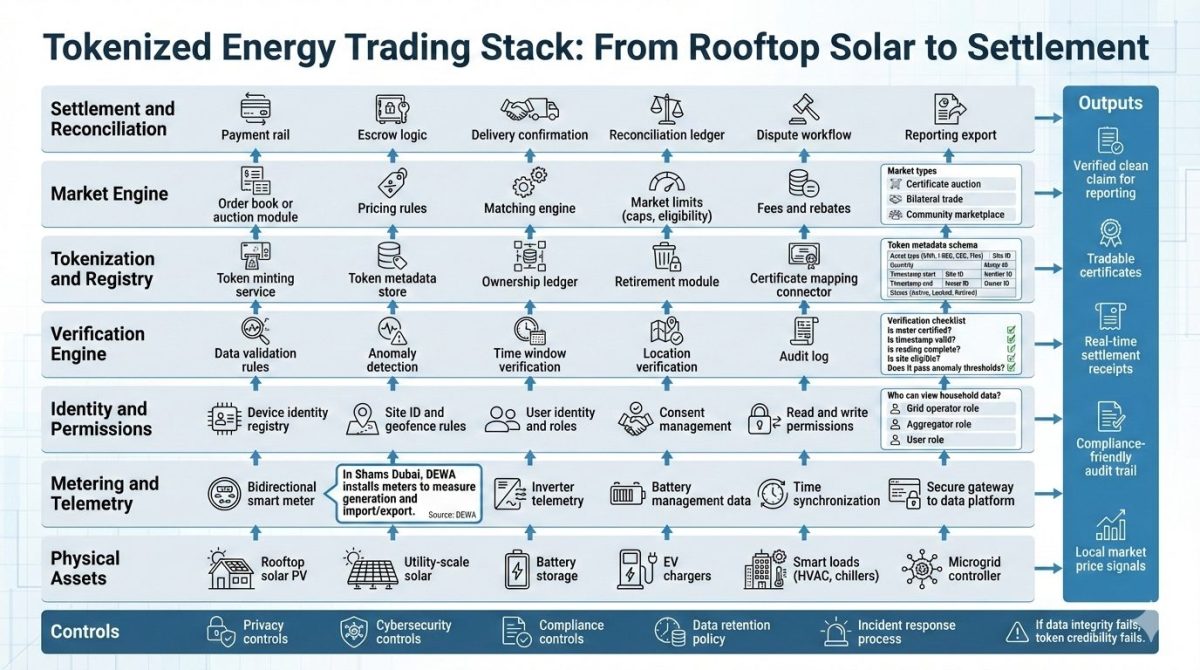
4) The platform stack you must build
A decentralized energy marketplace is a full product, not just a blockchain choice.
Layer 1: Physical assets
- rooftop solar
- community solar
- batteries
- EV chargers
- controllable loads
Layer 2: Metering and telemetry
- smart meters
- secure gateways
- time sync
Layer 3: Identity and permissions
- device identity
- user identity
- role management
- consent and privacy controls
Layer 4: Verification engine
- data validation rules
- anomaly detection
- audit logs
Layer 5: Tokenization and registry
- issuance rules
- ownership ledger
- retirement rules
Layer 6: Market engine
- order book or auction logic
- pricing rules
- limits and eligibility
- dispute process
Layer 7: Settlement and compliance
- invoicing and reconciliation
- reporting exports
- regulated custody if needed
IRENA’s work on blockchain and peer-to-peer trading shows that local energy markets and new business models can emerge, but they require system integration and governance. IRENA’s 2025 report on digitalisation and AI also describes blockchain as enabling peer-to-peer trading in power system transformation contexts.
5) Smart contracts: what they do well in energy
Smart contracts shine when you need rules that execute the same way every time.
Market rules
- Match bids and offers
- Enforce time windows
- Enforce geographic constraints
- Apply fees and rebates
Settlement rules
- Lock funds in escrow
- Deliver tokens atomically
- Trigger penalty logic when delivery fails
Compliance rules
- Restrict who can trade
- Restrict what can be bought
- Enforce retirement for claims
In research reviews of transactive and peer-to-peer trading, governance, incentives, and enforcement mechanisms are repeatedly highlighted as key design points.
6) Real pilots: what they proved
Powerledger and Freo 48 (Fremantle)
The RENeW Nexus project report describes “Freo 48” as a peer-to-peer solar trading trial with 48 participants. Media coverage also reported that blockchain-based P2P solar trading was feasible, while tariff structures and market design remained limiting factors.
What this proved
- Metered transactions can be tracked and exchanged.
- Participants value local autonomy and transparency.
What it did not solve
- Full integration into national retail tariffs.
- Universal regulatory approval for broad P2P settlement.
IRENA’s view of peer-to-peer trading
IRENA frames peer-to-peer electricity trading as part of the innovation landscape. It also highlights the role of market rules, permissions, and regulation.
7) The UAE angle, indirect but concrete
The UAE story is strong because it already has credible “energy attribute” and “prosumption” rails.
A) Dubai: Shams Dubai as the prosumer base
DEWA’s Shams Dubai page states that customers can use electricity on-site and export surplus to DEWA’s network. DEWA’s FAQ also describes metering that measures generation, and also measures import and export with the grid.
Why this matters for tokenization
- You have measurement.
- You have export accounting.
- You have a real verification process.
That is the foundation for more granular market designs later.
B) Dubai: i-RECs and attribute trading
DEWA provides information on i-RECs and describes them as tradable attributes that can be unbundled from physical electricity. This connects directly to tokenization. A clean attribute is already a “unit of claim.” Tokenization can automate issuance, transfer, and retirement. It can also improve audit trails.
C) Abu Dhabi: Clean Energy Certificates scheme
Abu Dhabi’s Department of Energy explains that the Clean Energy Certificates Scheme allows certification of energy source used by businesses in Abu Dhabi. EWEC also announces auctions for Clean Energy Certificates. S&P Global reported that Abu Dhabi’s clean energy certificate system implements the I-REC Standard and is managed by EWEC as a single registrant under DOE supervision.
Why this matters
- A certificate market already exists.
- Auctions create price discovery.
- Tokenized workflows can reduce friction and improve auditability.
D) National direction: Net Zero 2050 and energy strategy
The UAE’s Net Zero 2050 Strategy is described on the UAE’s official platform, with an update dated October 6, 2025.
The UAE official platform also describes the UAE Energy Strategy 2050 and its targets and investment ranges.
These policies do not mandate tokenization. But they increase the demand for credible, clean claims, better reporting, and scalable market mechanisms.
E) Regulated digital assets infrastructure
If your design includes tradable tokens, custody, or stablecoin rails, regulation matters.
ADGM’s FSRA announced enhancements to its digital assets framework at Abu Dhabi Finance Week 2025. It stated that ADGM’s ecosystem includes over 20 regulated firms licensed for activities involving virtual assets or fiat-referenced tokens.
ADGM FSRA also announced that it finalised a regulatory framework for regulated activities involving fiat-referenced tokens in October 2025.
Why this matters for energy tokenization
- You can design settlement and custody with a clearer compliance path.
- You can keep markets institutional-grade.
8) The hard problems that decide success
Scalability
Energy creates microtransactions. That can crush slow networks and high fees.
Interoperability
Energy systems are fragmented. Meters and platforms vary widely. Reviews keep highlighting interoperability as a practical barrier.
Privacy
Smart meter data can reveal behavior. Privacy-by-design matters. You need:
- data minimization
- aggregation where possible
- consent and role-based access
Regulation and market structure
P2P trading depends on local rules. IRENA emphasizes the need for enabling frameworks and permissions.
9) Three deployment models that actually work
Model 1: Tokenized clean attribute registry
Best for: corporate reporting, certificate markets, audit trail upgrades.
What you build:
- issuance and retirement registry
- verification workflows
- integrations with certificate issuers
- corporate dashboards
Why it works in the UAE:
- i-RECs and CECs exist today.
Model 2: Tokenized flexibility market for buildings
Best for: districts, large facilities, and industrial zones.
What you build:
- baseline and measurement rules
- dispatch and penalty logic
- aggregation layer
Why it fits:
- Large loads are easier to verify than households.
- Value per participant is higher.
Model 3: Community market pilots with tight boundaries
Best for: controlled pilots, microgrids, and new developments.
What you build:
- participant onboarding
- metering integration
- a simple market UI
- reconciliation with the utility
This is where “P2P electricity” can be tested safely.
The Grid, The Token, and The Modern Energy World
Tokenization will not replace the grid. It will make grid participation more modular.
The winners will be the teams who treat tokenization like infrastructure: measurement, verification, settlement, and compliance stitched together into a product that normal people can use.
If you are exploring energy asset tokenization or market design in the UAE, the strongest approach is to start with one narrow, regulated use case, prove the data and settlement loop, then expand.
FAQ
Is tokenized energy trading the same as selling electricity to my neighbor?
Not always. Many systems tokenize attributes or flexibility first. True P2P settlement depends on local market rules.
Does Dubai support exporting rooftop solar energy?
Yes. DEWA states that surplus electricity is exported to DEWA’s network under Shams Dubai.
Does Abu Dhabi have clean energy certificates?
Yes. The Department of Energy describes a Clean Energy Certificates scheme. EWEC also runs auctions for these certificates.
What is the biggest technical risk in tokenizing energy?
Bad data. Weak metering integrity breaks verification, settlement, and trust.
What is the safest first use case in energy tokenization?
Tokenized clean attributes with clear issuance and retirement rules.