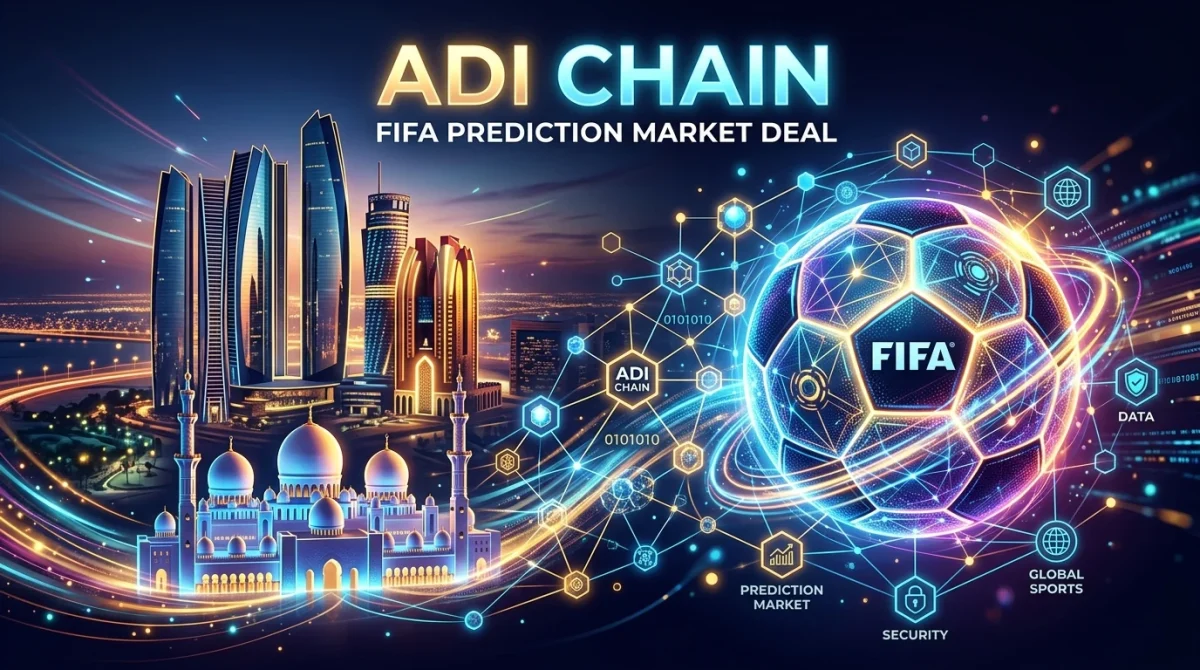

ADI Predictstreet, a prediction market platform built on the Abu Dhabi blockchain ADI Chain, was named FIFA’s official prediction market partner under a multi-year agreement signed ahead of the 2026 World Cup, becoming FIFA’s first official partner in that sector. The financial terms were never disclosed, but the deal is estimated to be worth $150 million, in line with other top-tier World Cup sponsorship agreements. The company is controlled by the same Abu Dhabi royal investment vehicle now tied to a stake in Donald Trump’s crypto venture, and its real-world trading volume has been dwarfed by the two competitors, Kalshi and Polymarket, that FIFA’s “exclusive” deal was supposed to shut out.
The Announcement Nobody Saw Coming
On April 2, 2026, FIFA did something it had never done before. FIFA’s deal, announced April 2, is with ADI Predictstreet, which said it was launching on April 9. The name meant nothing to almost everyone in the room. Its Instagram account had only about 135 followers and made its first post on March 26, one week before the FIFA announcement, and its X account also launched in March 2026.
FIFA president Gianni Infantino signed it anyway. He was pictured signing the contract alongside principal council member of ADI Predictstreet, Ajay Hans Raj Bhatia. Infantino’s public line was pure fan-engagement boilerplate: “FIFA is committed to continually enhancing the fan experience and embracing innovation that brings supporters closer to the game.”
The industry’s reaction was less polished. “This is all very fishy,” a veteran sports partnerships executive told Front Office Sports, adding that if this were a more established operator with a track record, “it wouldn’t raise the same questions.”
And here’s the part that made it a story instead of a press release: the deal was called “exclusive” in the release, suggesting FIFA would not make a deal with Kalshi or Polymarket, the two companies that actually move the money in this industry.
Who (or What) Is ADI Predictstreet
Strip away the branding and ADI Predictstreet is a very new product sitting on top of a very new blockchain. ADI Predictstreet launched a prediction market platform designed for real-time forecasts on World Cup matches, going live on June 8, 2026, initially only in Gibraltar, and powered by the Abu Dhabi-based blockchain provider ADI Chain.
It is, in fact, the first consumer application built on ADI Chain, described as an institutional-grade Layer 2 blockchain infrastructure engineered to be compliance-ready. In plain terms: FIFA’s first-ever prediction market partner was also the flagship use case for a blockchain that barely had a track record of its own.
The Ownership Chain: Tracing the Money to Abu Dhabi
This is where it gets interesting. Nothing about ADI Predictstreet is a standalone startup story.
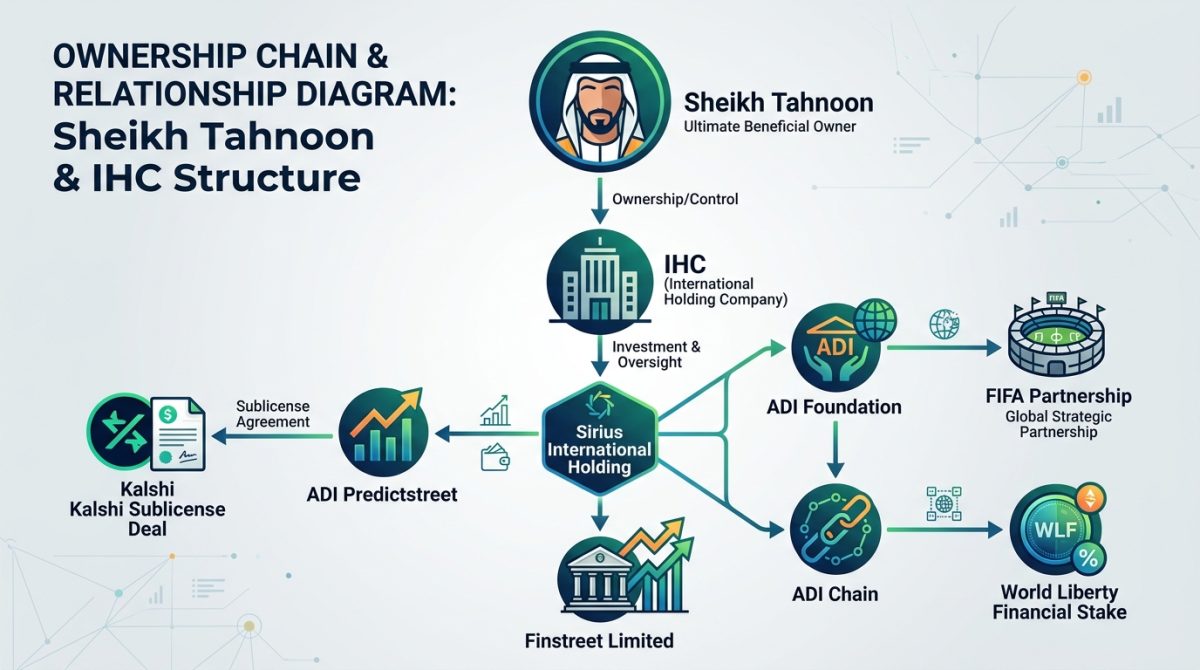
ADI Predictstreet is billed as a subsidiary of Finstreet Limited, which is owned by the Abu Dhabi royal family’s International Holding Company, and it’s built on ADI Chain, run by the nonprofit ADI Foundation, which was founded by Sirius International Holding, also owned by IHC.
Follow that chain far enough and it lands on one man. The International Holding Company is chaired by Sheikh Tahnoon bin Zayed al Nahyan, the brother of the United Arab Emirates’ president and ruler of Abu Dhabi, Sheikh Mohamed bin Zayed Al Nahyan, and Tahnoon oversees a business empire of more than $1.3 trillion. He is also the UAE’s national security advisor.
Every entity in this story, the blockchain, the prediction market, the FIFA contract, traces back to the same royal balance sheet. See the full breakdown in the diagram below.
The Red Flags: Licensing, Leadership, and the AML Question
Three separate problems surfaced almost immediately.
Licensing. Unless additional licenses came through, only fans in the 35,000-person island of Gibraltar would be able to legally use ADI Predictstreet during the World Cup, although others could use a VPN. It received its license from Gibraltar just days before it announced the World Cup sponsorship, and its website wasn’t even processing trades until shortly before the tournament began.
Leadership. ABC News reported that Ajay Bhatia, the executive who appeared on stage representing ADI Predictstreet at the FIFA unveiling, had settled an insider-trading lawsuit in India; Bhatia denied wrongdoing. Separately, investigative outlet Josimar examined CEO Dimitrios Psarrakis and his reported links to Qatargate, the EU Parliament lobbying scandal.
Compliance. Josimar also scrutinized the company’s money-laundering reporting officer, Colin Piri, citing a previous Gibraltar regulatory ban connected to AML shortcomings at a prior employer.
None of this is a smoking gun on its own. Together, it’s a résumé that would sink most fintech partnerships long before they reached FIFA’s boardroom, let alone a global tournament expected to reach billions of fans.
The Twist: FIFA’s “Exclusive” Partner Sublicenses to Its Own Rival
Here’s where the story turns from odd to genuinely funny, in a bleak sort of way.
Once the tournament kicked off, ADI Predictstreet’s own trading numbers were disastrous. So it did the one thing an “exclusive” partner isn’t supposed to do: it went shopping for the competition.
When the World Cup knockout round began, Kalshi joined the likes of Coca-Cola, Visa and Adidas with sideline advertising in the stadiums, an unusual addition given the event was already halfway over and FIFA had already signed an official prediction markets partner in ADI Predictstreet. But top billing had failed to direct significant business to ADI Predictstreet, so Kalshi, which had balked at FIFA’s $150 million asking price for sponsorship, agreed to a deal for co-branding through the remainder of the event.
The price for that side door was a fraction of the original ask. For the tie-up, which put Kalshi’s logo alongside ADI Predictstreet’s during games, Kalshi agreed to pay roughly $20 million. Sources told Front Office Sports that Kalshi and Polymarket had both been in the running for the original FIFA partnership but balked at the reported price tag for what amounted to a temporary partnership during the World Cup.
So the company FIFA’s “exclusive” deal was designed to lock out ended up on the same sideline boards anyway, at roughly one-seventh the price its rival paid FIFA directly. Although Kalshi is not an official FIFA partner, the arrangement gives it visibility at the tournament while ADI Predictstreet retains its official designation.
Polymarket, for its part, didn’t need a side door at all. Without a deal, Kalshi calls the tournament the “World Soccer Cup,” though Polymarket calls it the “2026 FIFA World Cup,” and a FIFA spokesperson did not immediately respond when asked if this violates the tournament’s strict branding rules.
The Numbers Don’t Lie
If you want the cleanest illustration of what “official partner” actually bought FIFA, look at trading volume on the exact same market across all three platforms.
On the World Cup winner market: Polymarket recorded $3 billion in volume, Kalshi recorded $500 million. On ADI Predictstreet, the official prediction market partner of the World Cup, volume was just $57,000.
It gets worse at the individual-match level. Despite prominent advertising during games, ADI Predictstreet attracted less than $100 in total trading for several first-round matches, events that drew tens of millions in betting on other platforms, while Kalshi facilitated $589 million in trades on the same event. At one point, around $400,000 had been traded on the winner of Mexico’s Group A on ADI Predictstreet, while just $13 had been traded on Algeria–Austria, and $17 on Croatia–Ghana.
Meanwhile the platforms ADI was supposed to shut out kept setting records. Kalshi’s aggregated open interest crossed $1 billion for the first time during group stage play, and it reported $17 billion in World Cup trading volume in the first two weeks alone, with daily fees exceeding $10 million. Bank of America estimated Kalshi accounts for roughly 89% of measured U.S. prediction market volume.
There was also a housekeeping problem underneath the volume gap. ADI Predictstreet kept some trading markets active after the outcome was already settled, including letting users trade on which team would win Group A after Mexico had already clinched the top spot.
The Bigger Picture: Petrostates, Trump, and World Liberty Financial
Zoom out and this deal fits a pattern FIFA has leaned into for years. Other Gulf states like Qatar and Saudi Arabia have been key financial partners and World Cup hosts for Infantino’s FIFA, and some experts view the ADI Predictstreet deal as Infantino trying to forge another alliance with a wealthy petrostate.
The Abu Dhabi connection also runs somewhere far more politically charged than football. Shortly before Trump’s inauguration in early 2025, a company backed by Tahnoon made a secret $500 million deal to buy 49% of the Trump family’s cryptocurrency company, World Liberty Financial, a stake that wasn’t reported until a year later by the Wall Street Journal. After Tahnoon visited Trump at the White House in March 2025, the UAE agreed to invest $1.4 trillion in the U.S. over the next decade, and just a few months later the Trump administration greenlit a deal for the UAE to purchase hundreds of thousands of American-made AI chips.
Nobody has produced evidence linking the FIFA deal directly to that arrangement. But it’s the same investment family, the same year, and the same broader push by Abu Dhabi capital into crypto infrastructure, sports, and now, American politics all at once. World Liberty Financial did not respond to a question about whether it has any involvement with ADI Predictstreet.
So Why Did FIFA Actually Do This?
One read, from Rice University’s Baker Institute Middle East fellow Kristian Coates Ulrichsen, is that ADI Predictstreet could be a way into the UAE or Abu Dhabi, which “have huge amounts of capital and investment opportunities” FIFA may not have previously tapped. He put it more bluntly: “Infantino has found in Gulf leaders a willing partner, and that has obviously played well with Infantino’s own desire to monetize almost every aspect of FIFA’s operations.”
That’s the whole story in one sentence, really. Whether ADI Predictstreet ever becomes a real prediction market or simply cashes its FIFA check and fades once the trophy is lifted on July 19, the deal has already done what it needed to do: it got Abu Dhabi’s flag planted at the center of the biggest stage in sports, logo included, receipts optional.
The open question isn’t whether ADI Predictstreet will out-trade Kalshi or Polymarket. It won’t. The real question is whether FIFA just wrote the opening chapter of how national wealth funds buy their way into global sport’s next monetization frontier, one obscure “official partner” contract at a time.
FAQ
What is ADI Predictstreet?
ADI Predictstreet is the prediction market platform named FIFA’s official prediction market partner under a multi-year agreement signed ahead of the 2026 World Cup, marking FIFA’s first official partner in that sector.
Who owns ADI Chain and ADI Predictstreet?
Both trace back to the Abu Dhabi royal family’s International Holding Company (IHC), chaired by Sheikh Tahnoon bin Zayed al Nahyan, through subsidiaries Finstreet Limited (which owns ADI Predictstreet) and Sirius International Holding (which founded the ADI Foundation behind ADI Chain).
How much did FIFA’s deal with ADI Predictstreet cost?
The terms were never officially disclosed, but the partnership is estimated to be worth $150 million, in line with other top-tier World Cup sponsorship agreements.
Is ADI Predictstreet legal to use in the United States?
At launch it was only licensed to operate in Gibraltar, meaning most U.S. fans could not legally use it during the World Cup without a VPN. It later expanded into 23 U.S. states through a co-branded hub with Fanatics Markets.
Why did Kalshi partner with ADI Predictstreet if FIFA’s deal was supposed to be exclusive?
After ADI Predictstreet’s own trading failed to materialize, Kalshi agreed to a co-branding deal for the remainder of the tournament, reportedly paying roughly $20 million for stadium and broadcast visibility it hadn’t been able to buy directly from FIFA.
How does ADI Predictstreet’s trading volume compare to Kalshi and Polymarket?
On the World Cup winner market alone, Polymarket recorded $3 billion in volume and Kalshi $500 million, compared with just $57,000 on ADI Predictstreet.
What’s the connection between this deal and Donald Trump?
Shortly before Trump’s inauguration, a company backed by Sheikh Tahnoon made a secret $500 million deal for a 49% stake in the Trump family’s crypto venture, World Liberty Financial, the same investment network behind ADI Predictstreet, though no direct link between the two deals has been confirmed.