
There is a moment, somewhere between a tidy whitepaper and an actual order book, where a tokenized asset stops being a clever idea and becomes a regulated security. In the UAE, that moment now has a postcode. Several, actually.
The country spent the last few years quietly turning itself into one of the most thought-through tokenization environments on Earth, and 2026 is the year all that quiet planning got loud. Federal Decree-Law No. 32 of 2025 and Federal Decree-Law No. 33 of 2025 came into force on 1 January 2026, replacing the Securities and Commodities Authority with the new Capital Market Authority and bringing virtual assets fully within the federal capital markets’ perimeter. Dubai’s Land Department flipped the switch on real estate token resale on 20 February 2026. ADGM published fresh virtual asset guidance in March 2026 covering tokenized securities, DeFi protocols, and AI-driven trading.
If you are an issuer, an investor, or a compliance officer trying to read the room, the question is no longer “is this allowed?” It is “which of the four paths fits, what does it cost, and how fast can we get to a tradable token?” That is the trip we are taking in this article.
The 2026 Reset: Why the Rulebook Just Changed
Until last December, the UAE securities law still relied on a statute written in the year 2000. The old SCA had been doing heroic work bolting on virtual asset rules through cabinet decisions, but the underlying frame was creaking. FDL32 created the Capital Market Authority as an independent federal regulator with legal personality and a much wider mandate. FDL33 codified the licensing regime, expanded the list of regulated financial products, and said something genuinely new: virtual assets used for investment are financial products, full stop
The CMA inherited everything the SCA had, then got new toys: extraterritorial reach over firms targeting UAE clients from offshore, a recovery and resolution regime for systemically important entities, an Investor Protection Fund, a Settlement Guarantee Fund, and the power to settle criminal violations. Penalties for unlicensed financial activity now reach AED 250 million and a minimum one-year prison term. That is approximately USD 68 million of “please get the licence first.”
The free zones did not get folded in. ADGM (under FSRA), DIFC (under DFSA), and VARA in Dubai still run their own regimes. What changed is the mood music. The CMA now sits above as the federal anchor, free-zone regulators handle their territory, and everyone is talking to each other through cooperation arrangements that are still being negotiated.
The practical translation: a Dubai exchange that serves clients across the UAE may now sit under both VARA and the CMA. An ADGM tokenization platform issuing into the mainland needs to map its perimeter carefully. There is a one-year transitional grace period (from January 2026) for firms to regularize their status. Use it.
What “Tradable” Actually Means in the UAE Now
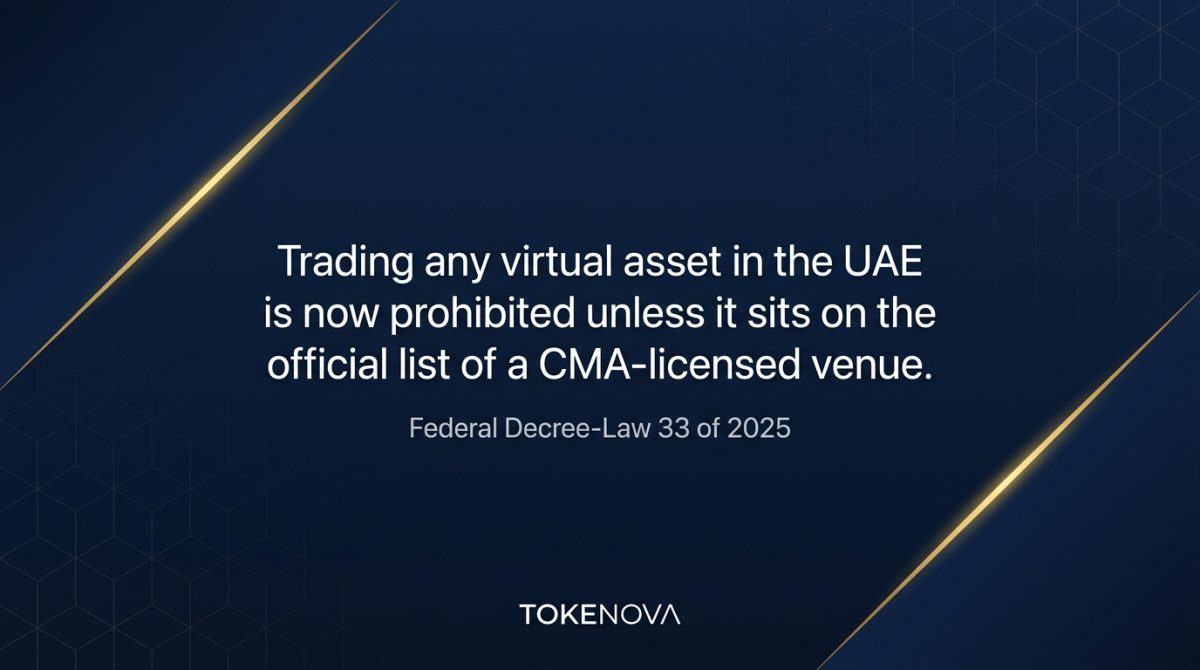
Article 39 of FDL33 introduces a concept that quietly reshapes the market: the Official List. Trading any virtual asset within the UAE is prohibited unless that asset has been admitted onto the Official List maintained by a CMA-licensed platform operator and registered with the CMA.
That single sentence does a lot of work. It means a token does not become tradable just because an exchange is willing to list it. It means tokens that exist happily in twenty other jurisdictions might still be untradeable in the UAE if they have not cleared the federal admission process. It means a private placement is not a backdoor; sooner or later, public trading needs federal sign-off or a free-zone equivalent.
Free zones still set their own admission and listing rules for tokens issued from within their territory. ADGM treats digital securities as securities and licenses Multi-lateral Trading Facilities to host them. DIFC, after its January 2026 amendments, requires firms to independently assess token suitability and ditched its old “Recognised Crypto Tokens” list, with only seven cryptocurrencies (BTC, ETH, LTC, TON, XRP, plus USDC and EURC stablecoins) currently usable by DIFC-authorised firms. DIFC’s separate Tokenisation Regulatory Sandbox, launched in March 2025, has already attracted 96 applications and is the door for tokenized equities, bonds, sukuk, and real estate. VARA hosts retail-facing tokens, including the asset-referenced category (ARVAs) used in the PRYPCO Mint real estate model.
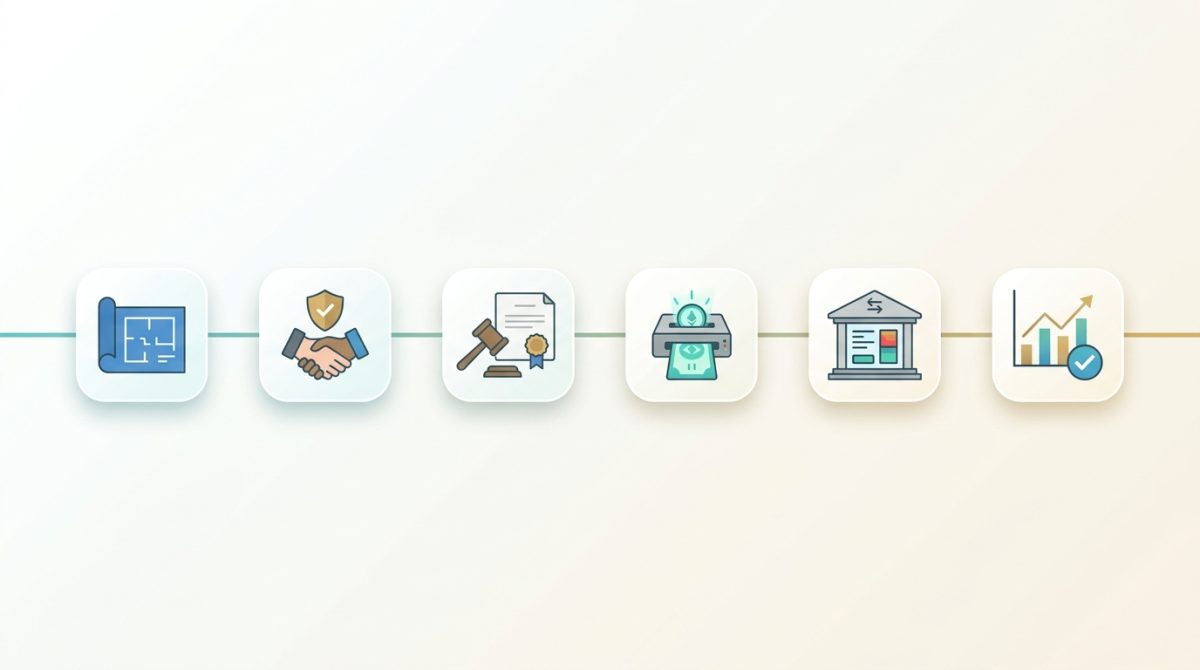
The Six Stages from Whitepaper to Order Book
Most successful tokenization projects in the UAE follow the same arc, even if the names on the doors differ.
Stage 1: Token design and legal structuring. Decide what the token actually is. Equity in an SPV? A debt instrument? A claim on income from an underlying asset? An access right? The economic substance dictates the legal classification, and the classification dictates the regulator. This is where most projects either save themselves a year of pain or sign up for it. Allow four to eight weeks if you are doing it properly.
Stage 2: Private placement to qualified investors. A controlled raise, usually to professional or accredited investors, with full KYC, AML, sanctions screening, source-of-funds checks, and a private placement memorandum that reads like a prospectus because, functionally, it is one. Marketing is tightly restricted; SCA-style “fair, clear and not misleading” rules apply across the board. Typical duration: one to four weeks once the documents are ready.
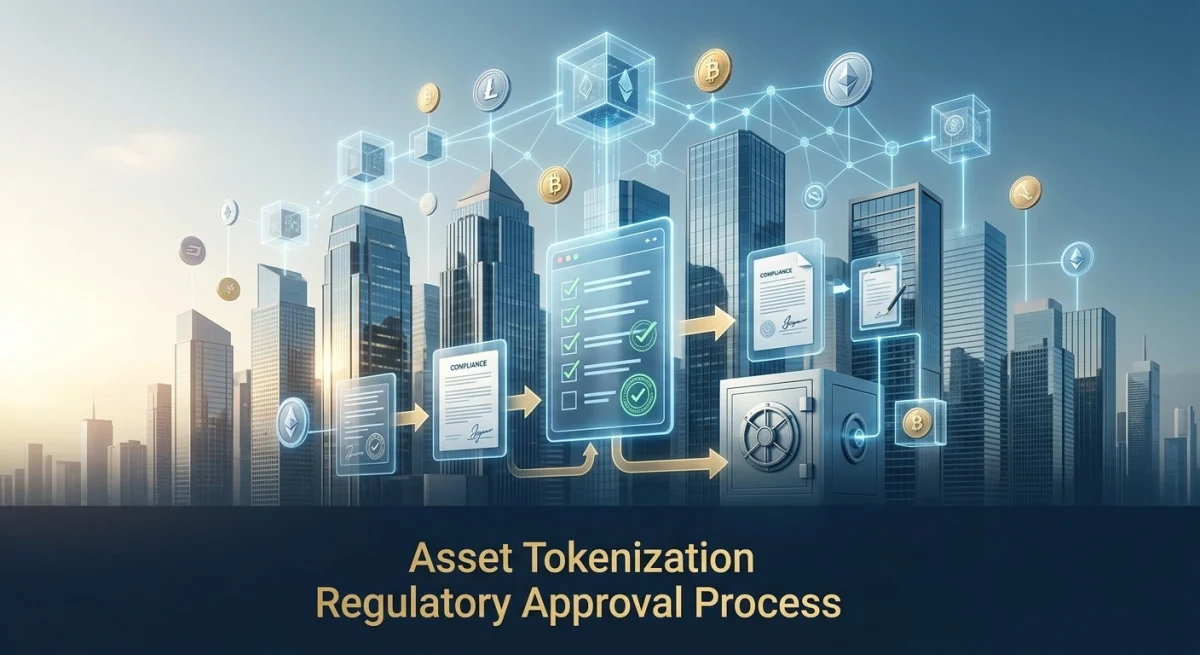
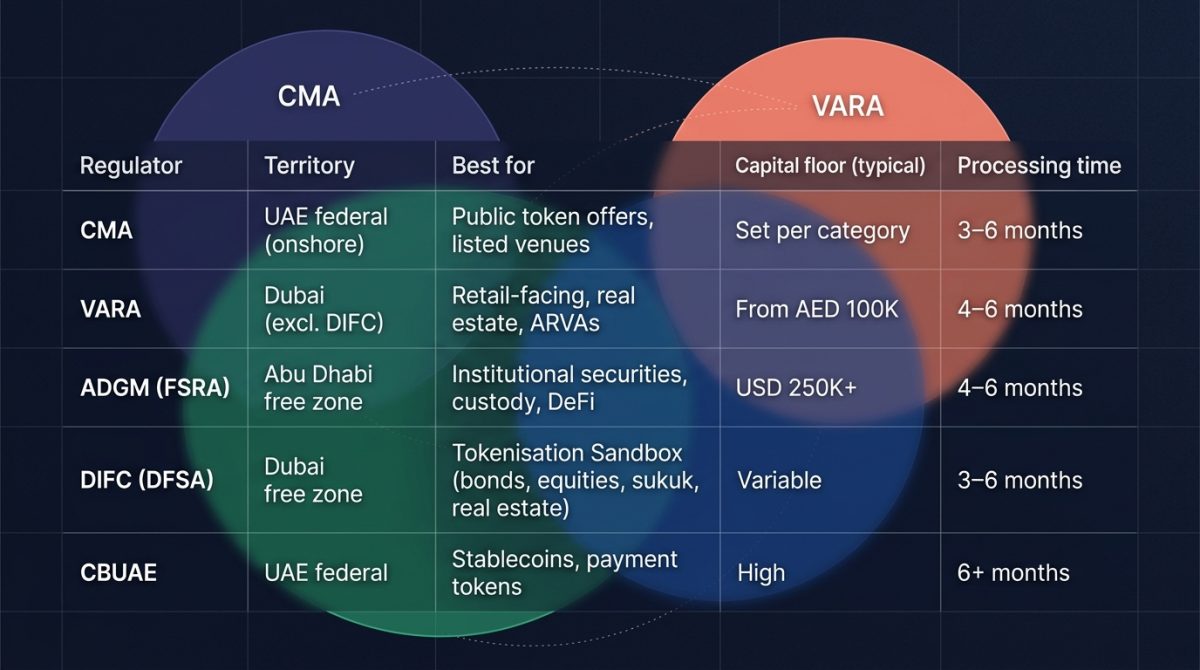
Stage 3: Regulatory approval and licensing. This is the longest stage and the one founders consistently underestimate. The issuer (or its platform partner) needs the appropriate licence: a CMA permission for onshore offers, an FSRA Financial Services Permission for ADGM, a DFSA authorisation for DIFC, or a VARA category licence for Dubai. ADGM application processing typically runs four to six months. VARA timelines are similar. Custodians, brokers, and exchanges all need their own permissions.
Stage 4: Issuance and disclosure. With approvals in hand, the tokens are minted and the offering document is finalised, often bilingually, with auditor sign-offs on reserves (for stablecoins or asset-backed tokens), AML certifications, and on-chain proof-of-reserves where applicable. For payment tokens, the Central Bank’s Payment Token Services Regulation imposes 1:1 reserve requirements and ongoing reporting.
Stage 5: Listing on a recognized venue. This is the big one. The token has to be admitted to a CMA-registered platform’s Official List, an ADGM MTF, a DIFC-licensed venue, or a VARA-approved trading platform. ADX and HSBC’s Orion platform have already proved the model works for digital bonds. PRYPCO Mint proved it works for real estate.
Stage 6: Secondary trading, custody, and settlement. Once live, the token trades under continuous market surveillance. Licensed custodians (with a strict whitelist for any self-custody) hold the assets. Settlement is recorded both on-chain and in the regulator’s books. The Investor Protection Fund stands behind eligible losses. Liquidity providers, market makers, and authorised brokers do their work, all inside the supervised perimeter.
Custody, AML, and the KYC Tax You Cannot Skip
Custody is no longer optional. Every UAE regime requires that tokens belonging to clients sit with a licensed custodian unless self-custody has been specifically approved against a published whitelist. ADGM allows tokenization platforms to use approved third-party custodians. VARA-licensed platforms typically use partners like Ripple Custody (the model used in the Dubai real estate project). DIFC and the CMA expect equivalent standards.
AML and CFT compliance flows from Federal Law 20 of 2018 and its updates, layered with FATF’s Travel Rule (adopted by FSRA in 2023 and now standard across regulators). Every onboarding is a workflow: identity verification, beneficial ownership, sanctions screening, PEP screening, source-of-funds, ongoing transaction monitoring, suspicious activity reporting. For platforms, this is not a feature, it is the floor.
Investor Protection and the New Penalty Regime
The new federal framework is not shy about enforcement. Under Article 71 of FDL33, conducting a regulated financial activity without a CMA licence carries imprisonment of at least one year and fines of up to AED 250 million. The CMA can settle criminally before charges are filed, write down or convert debt at troubled licensed entities, transfer assets to bridge institutions, remove management, and impose temporary stays on contractual termination rights.
For investors, the Investor Protection Fund and Settlement Guarantee Fund are the headline upgrades. Token issuers must segregate client assets, disclose material risks, and avoid improper issuance (tokens issued in error or with a “debit balance” can be voided). For unsophisticated buyers, the marketing rules and conduct standards are noticeably tighter than they were two years ago.
Tax Treatment in 2026: Still Friendly, No Longer Naive
The UAE remains one of the most tax-efficient places in the world to hold tokenized assets as an individual: no personal income tax, no capital gains tax. Businesses pay the federal 9% corporate tax on annual profits above AED 375,000, with potential 0% treatment for qualifying free-zone activities that meet the substance rules.
The interesting frontier is VAT. The Federal Tax Authority’s clarifications during 2025 made it clear that VAT treatment follows what the token actually represents, not the technology that records it. A token referencing real estate is taxed under property rules. A tokenised fund unit is treated under financial-service rules. NFTs are typically electronic services and not automatically exempt. The OECD’s Crypto-Asset Reporting Framework is now in the picture for cross-border data sharing.
Translation for issuers: tax planning needs to be designed in from the legal structuring stage, not bolted on after launch.
Three Live Case Studies Worth Studying
Dubai Land Department + PRYPCO Mint Phase 2 (live since 20 February 2026). This is the case study every regulator on Earth is reading. Phase 1, which ran from May 2025 to February 2026, attracted investors of more than 50 nationalities, raised over AED 18.5 million, and saw one Kensington Waters listing sell out in 1 minute and 58 seconds. Phase 2 turned on a regulated secondary market: roughly 7.8 million tokens covering ten properties, tradable 24/7 on the PRYPCO Mint app. Tokens are linked directly to DLD title deeds, recorded on the XRP Ledger, custodied by Ripple, and denominated in dirhams (not crypto). Sellers can list within ±15% of the displayed property valuation. Minimum entry: AED 2,000. The DLD’s stated target is to tokenize 7% of Dubai’s real estate market, around USD 16 billion, by 2033.
ADGM as the institutional default. The FSRA’s March 2026 update added a DeFi Protocol Operator category, refined rules for staking and yield, and clarified treatment of tokenized securities. This matters because ADGM, with its English common law foundation, is increasingly the venue of choice for tokenization platforms targeting institutional capital. Capital requirements start at USD 250,000 for most categories. Application processing runs four to six months. The strategic opportunity: a tokenized fund or digital bond launched from ADGM has a credible passport into institutional pools that VARA-only structures struggle to match.
The Singapore-UAE corridor (Alpha Ladder + Maqam, April 2026). On 2 April 2026, Singapore’s Alpha Ladder Group and Abu Dhabi’s Maqam International Holding announced a joint venture, domiciled in ADGM, to build RWA tokenization and digital payment rails between MENA and Asia. The JV will apply for an FSRA licence and launch operations later this year. The signal is unmissable: serious institutional capital is treating ADGM as the bridge between Gulf real assets and global on-chain liquidity. GCC RWA tokenization is being modeled as a USD 500 billion opportunity by 2030.
Practical Checklist for Founders and Issuers
Before you spend the first dirham on smart contract development, work through this:
- Define the token’s economic substance and decide the legal wrapper (SPV, fund, direct issuance).
- Map your target investors by jurisdiction and decide whether you need CMA, ADGM, DIFC, VARA, CBUAE, or a combination.
- Build a regulatory perimeter map showing every counterparty, custodian, and venue and the licence each one needs.
- Budget realistically: AED 600K to AED 1.4M+ for Year One depending on scope, plus capital adequacy.
- Choose a custodian early; they shape your tech stack more than you expect.
- Bake AML, KYC, sanctions screening, and Travel Rule compliance into the platform from day one.
- Plan the listing venue at the same time as the issuance, not after.
- Run a tax and VAT readiness review before the legal wrapper is locked.
- Prepare bilingual disclosure documents (Arabic and English) and have them auditor-reviewed.
- Build a marketing plan that lives entirely inside SCA-style “fair, clear, not misleading” rules.
Where Tokenova Comes In
This is exactly the work Tokenova’s tokenization advisory was built to do. Our team maps your token to the right UAE regulator, structures the SPV or fund vehicle, runs the licensing pathway with CMA, ADGM, DFSA, VARA, or CBUAE, designs the custody and AML stack, and walks you through to the first trade.
If your team is staring at FDL33 and wondering which page applies to you, schedule a compliance review or join the Tokenova newsletter for periodic briefings on every UAE rule change that touches tokenized assets.
The window for early movers is real, and it is closing at the speed of regulation.
FAQ
Are tokenized assets legal to trade in the UAE in 2026? Yes, but conditionally. Federal Decree-Law 33 of 2025 makes it illegal to trade any virtual asset in the UAE unless that asset sits on the Official List maintained by a CMA-licensed platform operator and registered with the CMA. Free zones (ADGM, DIFC) and VARA in Dubai run parallel regimes for security tokens, ARVAs, fiat-referenced tokens, and the short list of recognised crypto tokens. Translation: a token tradable in Singapore is not automatically tradable in Abu Dhabi.
What is the difference between a private token sale and a public listing in the UAE? A private sale is a closed offer to qualified or professional investors with full KYC, AML, and source-of-funds checks, governed by strict promotion rules. A public listing means the token has been admitted to an official trading venue (ADX, DFM, an ADGM MTF, a DFSA-licensed venue, or a VARA-approved platform such as PRYPCO Mint) and retail investors can buy and sell under continuous market surveillance. Private sales happen in months. Public listings are the destination, not the starting line.
Which UAE regulator should a token issuer actually choose? It depends on three things: what the token represents, who the investors are, and where the venue sits. Onshore offers to UAE residents fall under the CMA. Dubai retail tokenization (especially real estate) usually sits with VARA. Institutional security tokens, tokenised funds, digital bonds, and tokenization platforms serving global institutions typically choose ADGM under FSRA. DIFC’s Tokenisation Regulatory Sandbox is the door for tokenised equities, bonds, sukuk, and real estate under the DFSA. Stablecoins and payment tokens fall under the Central Bank.
How much does it cost to launch a tokenized asset in the UAE? Application fees are the least of your worries. Realistic Year One totals (legal, licence, technology, custody integration, audits, capital adequacy, and staffing) run roughly AED 600,000 for a basic advisory setup to AED 1.4 million or more for an exchange or custody licence in ADGM or VARA. Timelines from kickoff to first trade typically land between four and ten months. Anyone quoting you AED 40,000 and 30 days is quoting you the application form, not the project.
How are tokenized assets taxed in the UAE? Individual residents pay zero personal income tax and zero capital gains tax on token and crypto gains. Businesses pay the 9% federal corporate tax on annual profits above AED 375,000, with possible 0% treatment for qualifying free-zone activities that meet substance rules. VAT treatment follows what the token represents, not what blockchain hosts it: tokenised real estate is taxed under property rules, tokenised fund units under financial-services rules, NFTs usually as electronic services. The UAE also implements the OECD Crypto-Asset Reporting Framework for cross-border data sharing.
Can foreign investors buy tokenized real estate in Dubai? Not yet, at least not at retail. Phase 2 of the Dubai Land Department project, live since 20 February 2026 through PRYPCO Mint, restricts secondary trading to UAE residents aged 18 and over with a valid Emirates ID. International retail access is on the roadmap but has no confirmed date. Institutional foreign investors can already access tokenised UAE assets today through ADGM or DIFC-regulated structures, which is where most cross-border capital is flowing.