
Crypto Game Development and Tokenization Guide for 2025
Crypto game development is game bu+ilding where key assets, rules, and economies are enforced by smart contracts so players can own and trade items and participate in tokenized value loops.
Nowadays, Crypto game development is not “add NFTs, launch a token.” That era washed out. The winners in 2025 build real games first. They use tokenization where it improves gameplay, ownership, or distribution.
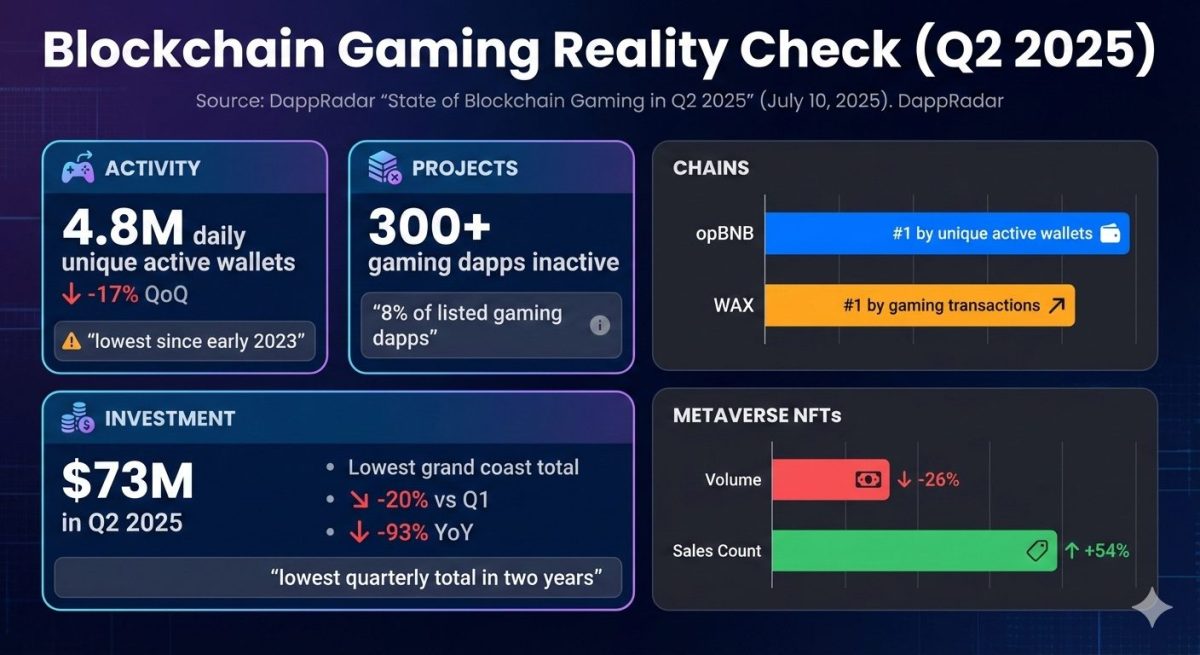
The market also got more selective. In Q2 2025, blockchain gaming activity fell 17% quarter over quarter to 4.8M daily unique active wallets, investments dropped to $73M, and 300+ gaming dapps went inactive. At the same time, major Web2 brands still pushed in. That mix tells you the truth. The space is resetting, not disappearing.
This guide shows you how to build a sustainable Web3 game and how to position yourself for work in tokenization roles. It stays practical and security-first.
1) What is a Web3 game in 2025
A Web3 game is a game where some assets, rights, or economic rules are enforced by smart contracts. The chain is not the game. It is the settlement and ownership layer.
In practice, this usually means:
- Players own items as NFTs or semi-fungible tokens.
- A token is used for fees, crafting, governance, or access.
- Key outcomes are verifiable, like minting, rewards, or scarce drops.
- Trading can happen outside the studio’s servers.
Teams that thrive treat tokenization as a tool. They do not treat it as the product.
2) The 3 Web3 game models that consistently work
Interoperability in the Tokenized Economy | Chainlink Labs’ Danielle Tamasi at SmartCon 2025
Model A: Cosmetic ownership + creator economy
Best for mainstream onboarding.
- NFTs are skins, collectibles, badges, pets, and land cosmetics.
- The economy relies on identity, status, and social signaling.
- You monetize via primary sales, royalties, and seasonal content.
Royalty signaling is often implemented with the NFT royalty interface standard so marketplaces can read royalty info.
Model B: Season-based “play and earn” with capped emissions
Best for competitive games and live service loops.
- Rewards are seasonal, not infinite.
- Emissions are tied to active player pools and measurable participation.
- Payouts use vesting, cooldowns, and anti-bot scoring.
A good public example is how Illuvium describes scaling reward pools, eligibility gates, and partial vesting options in its rewards system updates.
Model C: Fully on-chain or heavily on-chain games
Best for niche communities and composability.
- More logic and state lives on-chain.
- You get composable ecosystems and provable fairness.
- You pay in complexity, latency, and cost.
This model is real, but you must design for it from day one.
3) Tokenization building blocks you must understand
Assets
- ERC-721: unique NFTs.
- ERC-1155: batch minting and semi-fungible items. Often better for games.
Identity and wallets
- Embedded wallets reduce friction.
- Account abstraction and gas sponsorship improve UX.
- Always design for recovery and customer support.
Randomness
If your game needs fair drops or traits, use verifiable randomness. Chainlink VRF v2.5 is a common approach and its docs maintain a list of supported networks.
Indexing
Most games need an indexer. You will not query the chain state directly for every screen.
4) Architecture that scales without killing UX
Rule of thumb
Put ownership and scarce actions on-chain. Keep moment-to-moment gameplay off-chain.
On-chain candidates
- Minting, crafting finalization, and scarce drops
- Marketplace settlement
- Reward claims and season settlement
- Governance and treasury controls
Off-chain candidates
- Combat simulation
- Matchmaking
- Real-time physics
- Anti-cheat
Why this is the default in 2025
The market is harsh on projects with weak retention and fragile economies. DappRadar’s Q2 2025 report highlights shutdowns tied to delays, overpromising, and poor traction.
5) Tokenomics that do not implode
Tokenomics is game economy design plus market reality. You are shipping a live economy.
The four numbers you must control
- Emission rate (how much enters circulation)
- Sinks (how much leaves circulation)
- Velocity (how fast tokens move)
- Utility (why anyone holds or spends)
Token types that reduce chaos
- In-game utility token for spending.
- Governance token for voting and long-term alignment.
- NFT assets for identity, scarcity, and trading.
Avoid “one token does everything.” It makes volatility contagious.
Sinks that feel like gameplay
- Crafting and upgrading
- Entry fees for ranked modes
- Cosmetics and battle passes
- Seasonal rerolls and limited mints
If sinks feel like taxes, you lose players.
Anti-bot fundamentals
- Time-based cooldowns
- Proof of play signals (quests, skill, match completion)
- Sybil resistance scoring
- Claim throttles and vesting
6) Smart contracts: modules, standards, and patterns
Core modules most studios ship
- Asset contracts (ERC-721 or ERC-1155)
- Marketplace (listings, bids, fees)
- Rewards (season settlement, claims, vesting)
- Randomness (VRF integration where needed)
- Treasury (multisig, timelock, role-based access)
- Admin safety (pause, upgrade policy)
Royalties
Use the royalty info interface so marketplaces can query royalty amounts. It is widely used as a minimal royalty signaling standard.
Tooling that teams use in 2025
Foundry has become the most popular Ethereum development environment in the Solidity community survey results, ahead of Hardhat.
7) Security and operations (what actually breaks)
Security is not a checklist. It is a system.
What the loss data says
In CertiK’s H1 2025 security reporting, total losses reached $2.47B across 344 incidents. Wallet compromise and phishing were dominant.
That means your biggest risk is often not a clever reentrancy bug. It is key control, permissions, and operational security.
Your minimum security baseline
- Multisig treasury control
- Timelocks on upgrades and parameter changes
- Least privilege roles
- Pausable contracts for emergencies
- Continuous monitoring and incident runbooks
- Independent audits plus a bug bounty
Trail of Bits has also emphasized designing protocols that can tolerate key compromise using multisigs and timelocks.
8) Launch, growth, and retention loops
Onboarding that converts
- Start with email or social login wallet.
- Sponsor gas for the first meaningful actions.
- Delay token talk until the player is having fun.
Live ops that supports token health
- Seasons with clear starts and ends
- Reward pools tied to active participation
- Content drops that add sinks
Metrics to track weekly
- D1, D7, D30 retention
- Payers, ARPPU, and conversion rate
- Token velocity and sink coverage ratio
- Marketplace liquidity and floor price dispersion
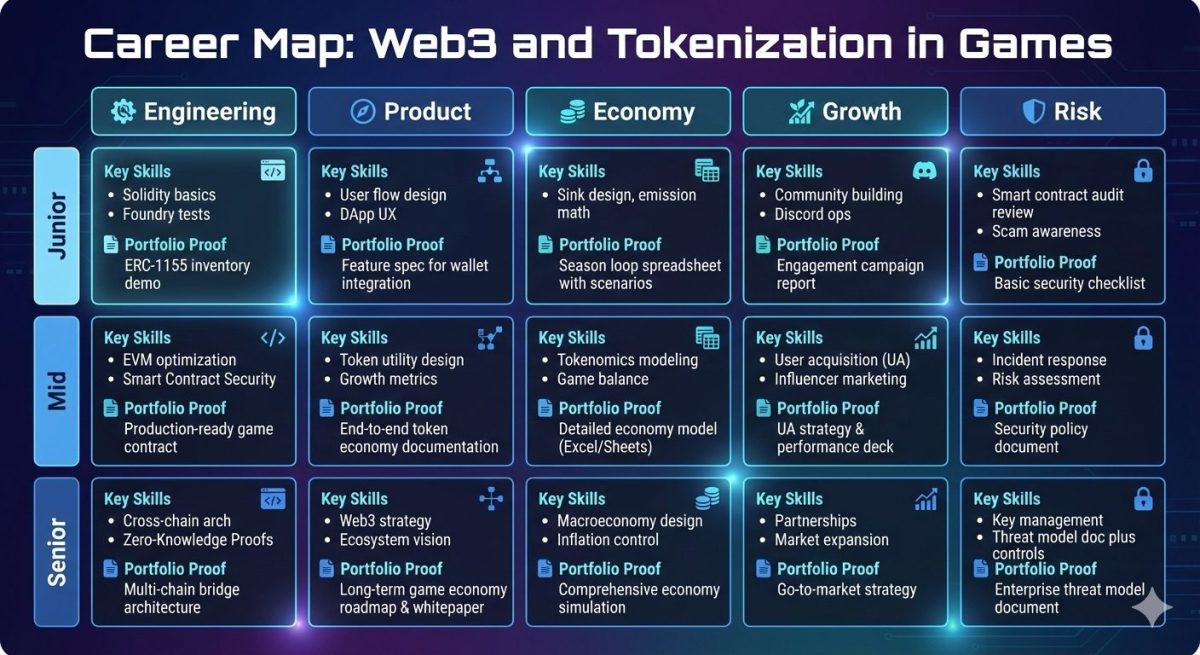
9) Career roadmap for tokenization and Web3 game roles
You can enter through games or through tokenization infrastructure. Both paths overlap.
High-demand roles
- Smart contract engineer (Solidity, Foundry, security)
- Tokenomics designer (econometrics, sinks, emissions)
- Product manager for wallets and onboarding
- Growth and ecosystem (partners, marketplaces, exchanges)
- Compliance and risk (policy, controls, vendor management)
- Data analyst for live economies
Skill stack that gets hired
Technical
- Solidity + Foundry testing
- EVM fundamentals and standards
- Indexing and event-driven backends
- Security patterns and threat modeling
Product
- Economy design, retention loops, pricing
- UX for onboarding and custody
- Marketplace mechanics and fraud controls
Proof of work
- One playable demo with an NFT item flow
- One audited mini protocol, even a simple crafting contract
- A public post-mortem on security choices and tradeoffs
Portfolio projects that signal maturity
- ERC-1155 game inventory + crafting sink
- Season rewards contract with vesting and cooldowns
- Marketplace with royalty info support
- VRF-based loot crate with provable randomness
Conclusion
Crypto game development in 2025 is a discipline that blends game design, tokenization, and security engineering. The market punished shallow projects, but it still rewards teams that ship.
If you want to build or get hired, focus on three things. Ship a fun loop. Prove ownership with clean contracts. Run your economy like a live product with real risk controls. The people who do that are the ones who last through the cycle.
12) FAQ
What makes a Web3 game “successful” in 2025?
Retention and economy control. Fun first. Tokenization second. Measured emissions always.
Should I put my whole game on-chain?
Usually no. Put ownership and scarce actions on-chain. Keep real-time gameplay off-chain.
What token standard is best for game items?
ERC-1155 is often best for inventories. ERC-721 fits unique hero assets.
How do I add royalties to NFTs?
Expose royalty info so marketplaces can read it. Use the standard royalty info interface.
How do I do fair loot drops?
Use verifiable randomness. Chainlink VRF v2.5 is a common approach.
What is the biggest security risk?
Operational security and key control. Loss reports show wallet compromise and phishing as leading vectors.
What tooling should I learn first for Solidity?
Foundry is a strong default in 2025 and leads in developer preference in the Solidity survey results.
Is Web3 gaming “dead” after the downturn?
No. Activity and funding dropped in Q2 2025, but major brands and top games kept shipping.