
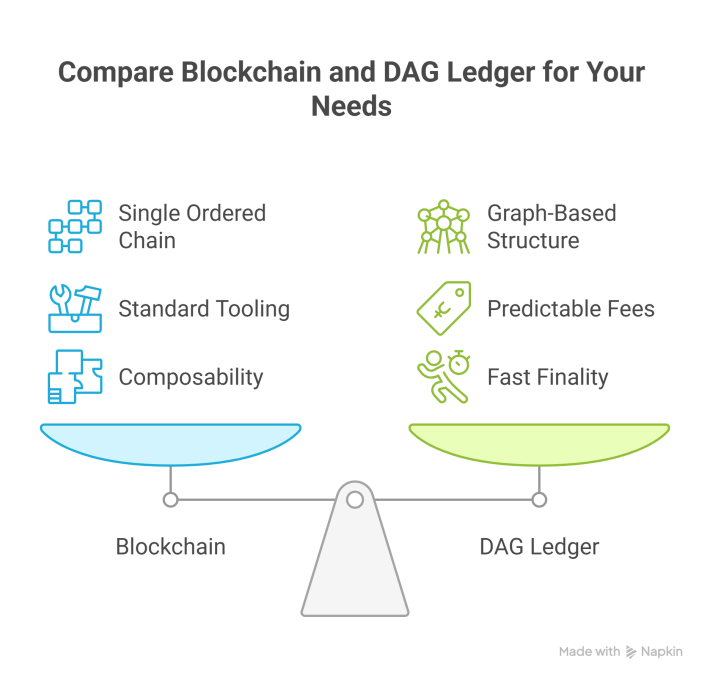
A blockchain records transactions in a single ordered chain of blocks. A DAG ledger records transactions as a graph where each transaction can reference others. DAG designs can increase parallelism and reduce bottlenecks. Blockchains often win on standard tooling and composability. DAG ledgers often win on predictable fees and fast finality. Your best choice depends on your settlement needs, compliance constraints, and developer ecosystem.
The real question you are asking
If you are building in a high-compliance market, “tech choice” becomes a business choice. You need:
- Predictable fees you can model in contracts.
- Finality you can explain to auditors and banks.
- Governance you can defend in risk reviews.
- Tooling that keeps your team fast and safe.
What a blockchain is in one minute
A classic L1 blockchain batches transactions into blocks and orders those blocks in a single sequence. That single sequence is the point. It makes the state easy to reason about. It also creates a shared bottleneck.
Ethereum mainnet can process roughly ~15 transactions per second at L1, which is why rollups exist.
What a DAG ledger is in one minute
A DAG is a directed acyclic graph. There is no single “one block after another” lane by default. Multiple transactions can be created and referenced in parallel. The ordering rules come from the consensus design, not from a fixed block chain structure.
In IOTA’s Tangle model, a new transaction can approve earlier ones, which creates a graph of approvals.
Important nuance: “DAG” is not one thing
“DAG” is a data structure. It is not a full specification. Two DAG systems can behave very differently on:
- Finality and reorg risk
- Validator sets and decentralization
- Smart contract model and composability
- Fee policy and spam resistance
So do not buy “DAG is faster” as a blanket rule.
Decision matrix for 2025
Use this matrix when you care about production, not demos.
| Requirement | If you answer “yes” | Bias toward |
| Do you need the deepest DeFi liquidity and EVM standards? | You want maximum compatibility | Ethereum L1 + L2 |
| Do you need predictable, low, fixed fees for large volumes? | You need stable unit economics | Hedera-style services |
| Do you need “EVM apps” but want a DAG-native base for non-EVM flows? | You want both worlds | Hybrid stacks like IOTA + EVM layer |
| Do you need formal governance that risk teams can map? | You want clear accountability | Council or foundation-led governance |
| Do you need atomic composability across many dApps in one tx? | You rely on complex multi-step tx flows | Single shared state, or composability-first designs |
Compare the tradeoffs that actually change outcomes
1) Throughput and congestion
What is EIP-4844? | Blobs & Proto-danksharding
Ethereum L1 is intentionally conservative on throughput. It routes scale to L2 systems.
Hedera positions network services around low latency and high throughput, with fixed-fee pricing.
2) Finality you can put in a policy
Ethereum finality depends on PoS and confirmation rules. It is strong, but app teams still design for probabilistic conditions and L2 sequencing realities.
Some DAG systems aim for fast, deterministic finality patterns, but you must validate the exact model per network.
3) Fee predictability
If you bill customers in fiat, fee volatility becomes an ops problem. Hedera explicitly markets low and fixed fees for its services. Many EVM environments expose fee markets that swing with demand. That is why L2 fee management is a whole discipline.
4) Governance and decentralization optics
This is a make-or-break topic in regulated environments. Hedera mainnet consensus nodes are currently permissioned and operated by its Governing Council.
That can be a plus for some enterprise risk reviews. It can also be a negative if you need maximal permissionless decentralization. Hedera’s own materials describe a path toward permissionless consensus nodes in the future.
5) Developer ecosystem and time-to-market
EVM wins on standards, talent pool, and tooling. DAG-led ecosystems can be excellent, but you must plan for smaller hiring pools and more custom integration work.
Real networks to know in 2025
Ethereum L1 + L2
Ethereum L1 processes roughly ~15 TPS, so L2 is the practical scaling path. Ethereum’s Merge moved Ethereum to proof-of-stake and reduced energy consumption by ~99.95%. If you are building today, use Sepolia for app testing and Hoodi for long-term validator testing. Goerli is long past its useful life for most teams.
Also track the roadmap work that increases rollup data capacity. Ethereum’s Fusaka roadmap item and related testnet work are explicitly focused on blob throughput tuning.
Hedera
Hedera positions itself as an open-source, public proof-of-stake network, with “low & fixed fees” and “10k TPS” for its network services. For governance and node operations, the mainnet consensus nodes are currently permissioned and run by Council members.
IOTA and the EVM path
IOTA’s research content explains the Tangle model as a DAG where new transactions approve earlier ones. If you need EVM compatibility in the IOTA ecosystem, ShimmerEVM is positioned as an EVM environment for smart contracts in that stack.
Aleph Zero
Aleph Zero documents AlephBFT as a peer-reviewed consensus protocol presented at AFT 2019. Their docs also describe AlephBFT as a DAG consensus approach that enables parallel block creation and later ordering.
Radix
Radix markets a sharded design with a very large shard space and ties it to parallelism claims. If you care about composability language, Radix also documents “atomic composability” as a defined concept.
Fantom and Nano as architecture references
Fantom documentation describes a DAG-based structure for its consensus design. Nano documents its “Block Lattice” architecture, where each account has its own chain. These are useful when you want examples of how different DAG-like designs behave.
IOTA Quicktakes 08.12.2025: Hello USA with Layer Zero, Bitgo, Uphold; MOVEATHON & more
A practical selection framework for serious teams
Step 1: Decide what your ledger must prove
Pick one:
- Settlement finality for assets and obligations
- Audit trail for events and compliance logs
- High-volume micropayments with stable cost
- Smart contract execution with deep composability
If you mix these, do it intentionally. Many winning stacks are modular.
Step 2: Map legal and operational constraints to technical constraints
Ask these questions:
- Do you need predictable transaction costs for customer SLAs?
- Do you need governance that a risk committee can map?
- Do you need KYC, sanctions screening, and monitoring tooling compatibility?
- Do you need to explain finality and rollback rules to auditors?
Your answers usually narrow the field fast.
Step 3: Prototype with the right testnets
- Ethereum app testing: Sepolia is the common default.
- Ethereum validator testing: Hoodi is the long-term supported choice.
- Hedera: use their testnet and faucet to model real fee and throttle behavior.
Step 4: Treat cross-chain as a product, not a patch
If your design needs multiple chains, use a clear messaging model. LayerZero describes itself as an omnichain interoperability protocol for cross-chain messaging between blockchains. Then design your trust model. Document it. Make it auditable.
Common mistakes
- Picking an L1 based on peak TPS alone.
- Ignoring governance until procurement asks.
- Treating bridges as “just integrations.”
- Under-budgeting monitoring, custody flows, and incident response.
Conclusion
DAG vs blockchain is a systems design choice, not a culture war. If you need maximum standards and composability, EVM stacks with L2 are hard to beat. If you need predictable fees, fast finality, and governance clarity, some DAG-based ledgers can be a better fit. Start from your risk constraints, then pick the architecture. Your auditors will thank you later.
FAQ
Is a DAG faster than a blockchain?
Sometimes. DAGs can allow more parallel activity. Speed still depends on consensus, validator design, and network limits.
Do DAGs remove fees?
Not by default. Fee policy is a network choice. Always confirm the current fee model.
Is Ethereum still the best default for smart contracts?
It is still the default for standards, tooling, and L2 breadth. Ethereum L1 throughput constraints are real, which is why L2 is central.
Is Hedera permissionless?
It is a public network, but its mainnet consensus nodes are currently permissioned and run by Council members.
What is the simplest “safe” architecture in 2025?
For many teams: EVM app on an L2, settlement anchored to Ethereum, and a clear cross-chain messaging plan.