
Supply chain tokenization turns real-world goods, logistics assets, and trade documents into digital tokens that can move across a shared network. This creates a “digital passport” for items and a programmable layer for settlement, compliance, and reporting.
The timing is strong. Global trade reached a record $33 trillion in 2024, and services trade drove much of the growth. Counterfeit trade also remains large. The OECD and EUIPO estimate global trade in counterfeit goods at about $467 billion in 2021, or 2.3% of global imports.
For UAE-based builders, the strategy is clear. Start with traceability and paperwork reduction, then add tokenized settlement and financing. Dubai has pushed paperless government work at scale. The UAE also now has deeper digital asset rulebooks and legal frameworks across key jurisdictions.
Market signals shaping tokenized logistics
Global logistics is already massive, even if market sizing varies by definition. A common estimate is that the logistics market is roughly $10 trillion per year in the mid-2020s. The World Bank has also noted that logistics costs can average around 13% of GDP, based on scarce data.
Several recent signals explain why supply chain tokenization moved from “interesting” to “commercially necessary”:
First, trade volume continues to test old processes. UNCTAD reports global trade hit $33 trillion in 2024. It also highlights the split between services growth and slower goods growth.
Second, fraud and counterfeit risks remain material. The OECD–EUIPO estimate of $467 billion in counterfeit trade in 2021 is a direct pressure on brand owners and regulators to improve provenance and verification.
Third, product traceability is becoming a compliance requirement, not only a customer feature. The European Commission explains that the Ecodesign for Sustainable Products Regulation introduces a Digital Product Passport as a “digital identity card” that stores relevant product information.
Fourth, trade documentation is going digital at the industry level. DCSA states its member carriers have committed to 50% electronic bills of lading within five years and 100% by 2030, using standardized eBLs. McKinsey & Company estimates that adopting an electronic bill of lading could save $6.5 billion in direct costs and enable $30 billion to $40 billion in additional global trade volume.
Fifth, tokenization infrastructure is being productionized in mainstream finance. Goldman Sachs and BNY Mellon launched a tokenized money market funds solution that uses “mirror tokens” recorded via GS DAP, tied into BNY’s LiquidityDirect. This matters for logistics because the same token rails can support faster settlement, collateral workflows, and programmable payment terms for trade and supply chain finance use cases.
How supply chain tokenization works in practice
Tokenization is the creation of a digital representation of a real thing. In supply chains, the “real thing” can be a product unit, a shipment, a warehouse receipt, a container lease, or a bill of lading.
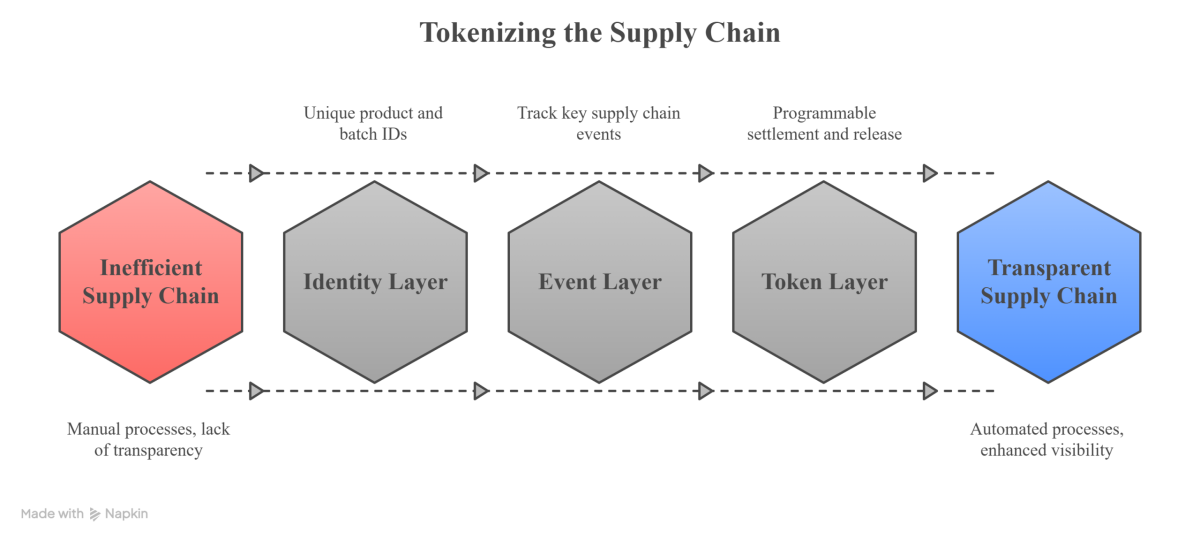
A practical model in 2026 has three layers:
The first layer is the identity layer. Each unit or batch gets a persistent identifier. A QR code is common for consumer access. A serialized identifier is common for regulated goods. This layer is where “digital product passport” concepts fit well.
The second layer is the event layer. Each meaningful action becomes an event. That includes “packed,” “loaded,” “customs cleared,” “temperature breach,” and “delivered.” This is where interoperability matters more than the blockchain brand name. GS1 positions EPCIS as a traceability event messaging standard that enables supply chain visibility by sharing event data in a common language.
The third layer is the token layer. Token objects represent rights and state. A token can represent “title,” “custody,” “inspection passed,” or “release-for-payment.” This is where smart contracts can turn business rules into automated logic.
A real-world example shows why teams care. In the well-known Walmart and IBM blockchain pilots, the reported time to trace mango origins shifted from days to seconds. That is not only a technical story. It is a recall cost story. It is also a customer trust story.
New revenue streams created by tokenized logistics
Traditional supply chains often monetize through margin, volume discounts, and service fees. Tokenization adds revenue models that rely on verifiable state, programmable rights, and reliable audit trails.
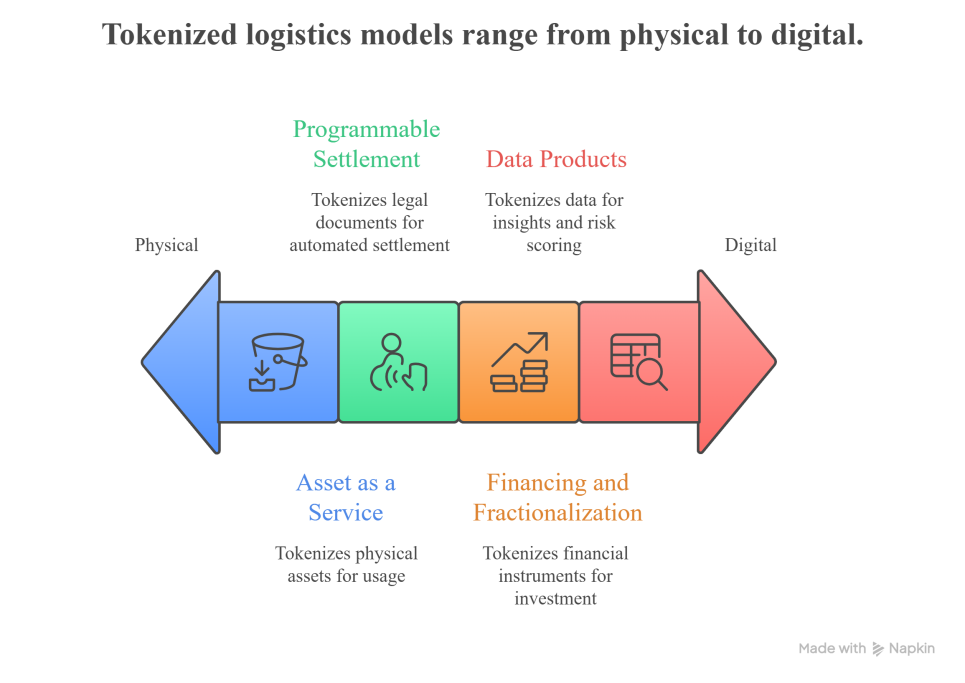
A common first model is tokenized logistics assets as a service. Think of containers, cold-chain equipment, or warehouse capacity. The token is not “a crypto coin.” It is a usage right that can be scheduled, transferred, or redeemed based on on-chain or signed events. This works best when tied to standard operational events and clear SLAs.
A second model is data monetization with consent and anonymization. Tokenized supply chains generate high quality event trails. Those trails support benchmarks like lane performance, dwell time, and exception rates. A venture can productize these insights as APIs for insurers, lenders, and enterprise shippers. This idea also aligns with the broader push for digitized trade documentation and interoperability across supply chain ecosystems.
A third model is tokenized trade documentation and programmable settlement. The shift to electronic trade documents is accelerating. The UNCITRAL Model Law on Electronic Transferable Records aims to support the cross-border use of electronic transferable records. When documentation becomes digital, token-based workflows can release goods and trigger conditional payments faster. This model is a strong fit for UAE trade lanes because it reduces paper friction and supports multi-party coordination.
A fourth model is tokenized micro-ownership and financing. This is powerful and risky. It can democratize participation in warehousing, containers, or invoice pools. It can also become a regulated financial product quickly. The right design depends on jurisdiction, investor type, and whether the token behaves like a security or a commodity interest.
Why the UAE is a natural launchpad for supply chain tokenization
The UAE is a logistics hub with global connectivity. DP World describes Jebel Ali Port as the world’s largest man-made harbour and a gateway for over 80 weekly services connecting more than 150 ports globally. This matters because tokenized logistics benefits from dense partner networks.
Digital government momentum also reduces adoption friction. Digital Dubai states Dubai aimed to go paper-free and eliminate more than 336 million sheets of paper used for government transactions each year. It also reports achieving the objectives of the paperless strategy.
Most importantly, the regulatory foundation for tokenization has matured. The Virtual Assets Regulatory Authority positions itself as the sole authority regulating virtual assets across Dubai’s free zones and mainland, except within the jurisdiction of DIFC. Dubai International Financial Centre has enacted a Digital Assets Law that sets legal characteristics of digital assets in its jurisdiction. Abu Dhabi Global Market has continued to refine its digital assets framework. It has also finalized rules relating to fiat-referenced tokens and discussed proposed staking regulations.
Tokenization has also moved from concept to live regional deployments. Dubai Land Department announced Phase II of its Real Estate Tokenization Project in February 2026, with resale activity in a controlled secondary market pilot and a reference to approximately 7.8 million tokens. While that is a real estate example, it signals operational readiness for regulated tokenization workflows in Dubai.
Implementation blueprint for a tokenized supply chain venture
Supply chain tokenization fails when teams treat it like a token launch. It succeeds when teams treat it like infrastructure and standards work.
A workable blueprint has five steps.
Start with a narrow pilot that has clear pain. Pick one product line, one corridor, or one compliance obligation. The best pilots focus on high-value or regulated goods, or on processes that are paper-heavy and dispute-prone.
Design around standards before chain selection. Use event standards that partners already understand. EPCIS is designed for event data sharing in a common language, so it reduces integration friction. This step usually matters more than choosing a public or permissioned ledger.
Make documentation a first-class citizen. Many “blockchain supply chain” projects stall because the bill of lading and other transferable records stay outside the workflow. The eBL commitment by major carriers and the legal push toward electronic transferable records both point in the same direction.
Add programmable settlement only after trust and data quality. Smart contracts can automate parts of delivery versus payment, but only if events are reliable. If IoT sensors are used, treat device identity and tamper evidence as part of the security model.
Build the compliance path early for the UAE. Jurisdiction matters. A token that represents title, fractional interests, or yield can trigger licensing needs. Dubai, DIFC, and ADGM have different scopes and rulebooks. Your product plan should include legal counsel, a clear token classification memo, and a distribution policy that matches your target users.
FAQ
What is supply chain tokenization?
Supply chain tokenization is the creation of digital tokens that represent real goods, logistics assets, or trade documents. These tokens can carry identity and state, so parties can verify provenance and automate workflows across the supply chain.
Does the EU require digital product passports?
The EU Ecodesign for Sustainable Products Regulation introduces a Digital Product Passport as a digital identity card for products, components, and materials. It is meant to store relevant information to support sustainability and compliance.
Why does eBL matter for tokenization?
Major container carriers have committed to move bills of lading to electronic form, targeting full adoption by 2030. McKinsey estimates eBL adoption could save billions in direct costs and unlock additional trade volume. This creates a strong base for programmable trade workflows.
Is supply chain tokenization the same as blockchain tracking?
No. Tracking records events. Tokenization also represents rights and state as digital tokens, which can be transferred and used in automated workflows.
What problem does tokenization solve first in logistics?
It usually solves fragmented data and paper-heavy handoffs. Digitized documentation and standardized events reduce disputes and speed up coordination.
What is the biggest risk in supply chain tokenization?
The biggest risk is weak linkage between the real world and the digital record. Data quality, device integrity, and partner incentives matter as much as the blockchain layer.
Why is the UAE a good place to build this?
The UAE has global logistics connectivity and has advanced digital government execution. It also has maturing digital asset frameworks across Dubai, DIFC, and ADGM.
How long does an enterprise pilot take?
A focused pilot can move fast if it touches one corridor and a small partner set. Wider rollouts take longer because they need integration, standards alignment, and legal readiness.
Do tokenized asset projects face extra regulatory risk?
Yes. Some token designs resemble regulated financial products. Recent global commentary also highlights investor protection and clarity of rights as key issues.