
Tokenized Carbon Credits in 2025: Benefits, Risks, and a UAE Build Guide
Carbon markets have scale, but they still struggle with speed, data consistency, and trust. Registries can be fragmented. Transactions can be slow. And proving retirement can still create friction for buyers, auditors, and ESG teams.
Tokenized carbon credits can help, but only when done correctly. Tokenization improves traceability, settlement, and automation. It does not automatically fix credit quality or climate claims. In 2025, the winning approach is simple: pair high-integrity credits with audit-ready tokenization rails.
Verra’s Verified Carbon Units (VCUs) represent one tonne of CO2e reduced or removed. That is the unit the market understands. Tokenization should respect that unit, not distort it.
What are tokenized carbon credits
Definition
Tokenized carbon credits are carbon credits represented as blockchain tokens so ownership, transfers, and retirement can be tracked with auditable records.
Benefits
- Better traceability and audit trails
- Faster settlement and access
- Clear retirement receipts
- Reduced reconciliation overhead
- New product design options for climate finance
Risks
- Credit quality risk is not solved by tokenization
- Registry alignment risk
- Claims risk for marketing and reporting
- Bridge and custody risk
Process
- Select eligible credits and integrity criteria
- Tokenize with metadata and controls
- Trade or allocate via permissioned access where needed
- Retire with an on-chain receipt
- Export audit packs for reporting and assurance
A carbon credit is a verified unit that represents emissions reductions or removals. Under Verra’s VCS program, each VCU equals one tonne of CO2e.
Tokenization represents that credit as a blockchain asset. This can be done in different ways:
- NFT mapping: one token maps to one unique credit with clear serial metadata
- Fungible pooling: standardized tokens represent a basket of similar credits
- Hybrid: NFTs for provenance plus fungible wrappers for liquidity
The key is alignment. Market integrity depends on how the token relates to registry status, ownership, and retirement.
https://www.youtube.com/watch?v=5bLyIG_QzRE
What tokenization changes, and what it does not
Tokenization can improve:
- transparency of transfers
- speed of settlement
- automation of retirement and reporting
- audit trails and data packaging
Tokenization does not guarantee:
- that the underlying credit is high quality
- that marketing claims are compliant
- that the credit will be accepted for a specific reporting framework
That is why integrity standards matter in 2025.
Key benefits of carbon credit tokenization
1) Transparency and traceability that teams can actually audit
In legacy workflows, verifying a credit’s path can be time-consuming. Data can be distributed across systems. That creates friction for buyers and assurance providers.
Tokenization creates a consistent transaction record. It can attach metadata like project type, vintage, method, and geographic details. It can also generate audit exports for ESG and finance teams.
This is one reason tokenization became popular fast. Toucan reported that over 20 million tonnes of carbon credits flowed onto the infrastructure it built within the first six months after launch.
Important integrity note: that early growth also triggered scrutiny about what kinds of credits were being bridged. Documented concerns about low-quality credits migrating on-chain, which is exactly why quality gates and eligibility rules now matter more than ever.
2) Liquidity and smaller ticket access
Traditional carbon transactions often favor large buyers and bespoke deals. Tokenization can support:
- fractional participation
- standardized lots
- 24/7 trading and faster settlement
- programmatic allocation across a buyer portfolio
KlimaDAO’s ecosystem reports over $4 billion in total transaction volume, which shows demand for more liquid, digital rails.
Liquidity is not the same as integrity. But liquidity matters when climate finance needs scale.
3) Retirement proof with “receipts” that are easy to verify
A practical benefit is clearer retirement evidence. When retirement is automated, a system can generate:
- a retirement transaction record
- a timestamp
- a reference ID
- a data package for auditors
This is also where teams must be careful. Registry rules and market expectations matter.
Overview of Final Consultation on Version 5 of the VCS Program
Verra publicly stated it would prohibit the practice of creating instruments or tokens based on retired credits, because retirement is understood as the consumption of the environmental benefit.
So the modern approach is not “tokenize by retiring and then trading the token.” The modern approach is registry-aligned tokenization with controls, so the token lifecycle does not create misleading claims.
4) Automation and cost reduction
Tokenization can reduce operational overhead through:
- smart contract settlement
- automated retirement workflows
- reduced manual reconciliation
- faster reporting exports and audit packs
Industry groups have been explicit that digital transformation can improve efficiency, transparency, and trust in carbon market infrastructure.
5) New climate finance product design
Once you have auditable rails, you can build products like:
- portfolio allocation tools for buyers
- programmable retirement schedules
- embedded disclosures for claims and reporting
- structured finance around future credit delivery
This is where Web3 teams can create real value, as long as they ship with integrity.
The integrity reality check in 2025
Credit quality still matters more than token format
In 2025, the market continues to move toward “flight to quality.” Buyers want stronger governance, better data, and clearer claims.
A core reference point is the Core Carbon Principles (CCPs) from ICVCM, which are designed to set a global benchmark for high-integrity voluntary carbon credits.
Align with CCPs, and make it visible in the product
Practical ways to bake this into tokenization:
- eligibility lists that exclude known problem categories
- metadata requirements tied to integrity checks
- provenance fields that are not optional
- restrictions on how tokens can be marketed or labeled
- reporting exports that support assurance work
Claims risk is real
Tokenization makes the asset easier to move. It can also make bad claims travel faster.
If your UI implies a “guaranteed climate impact,” you increase legal and reputational risk. Use precise language:
- “credit retirement record” instead of “guaranteed offset”
- “supports claims frameworks” instead of “fully compliant ESG”
- “audit export available” instead of “verified by blockchain”
A UAE-oriented build guide for Web3 teams
If you are building tokenized carbon credit infrastructure, the UAE is increasingly positioned as a serious base for regulated tokenization builders.
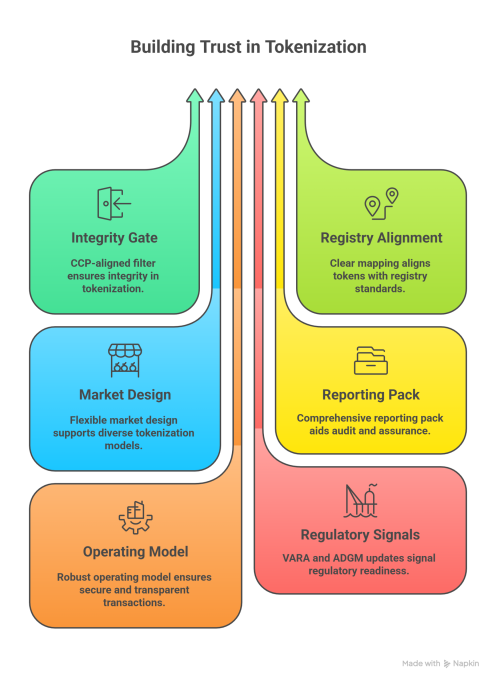
Dubai’s Virtual Assets Regulatory Authority (VARA) regulates and oversees virtual asset activities in and from Dubai. Abu Dhabi Global Market (ADGM) FSRA continues to update its digital asset regulatory framework and guidance.
Also, tokenization is not theoretical in the UAE. Dubai Land Department launched real estate tokenization initiatives tied to blockchain-based tokenization and fractional access.
Carbon credits are a different asset category from real estate. But the signal is clear: serious tokenization builders can find infrastructure, regulators, and market interest in the UAE.
UAE build checklist for tokenized carbon credits
Use this as your product design filter:
- A) Asset and integrity design
- Define eligible standards and project types
- Require provenance metadata and verification references
- Set rules for vintage, geography, and methodology
- Add quality gates aligned with CCP logic where possible
- B) Registry alignment and lifecycle controls
- Decide how on-chain tokens map to registry status
- Avoid models that imply retired credits can be traded as live value
- Build retirement as a terminal state with clear evidence
- C) Market structure
- Decide NFT vs fungible vs hybrid based on user need
- Use permissioned markets if buyer rules require it
- Support institutional workflows and audit exports
- D) Compliance-ready operations in the UAE
- Choose your operating zone based on your activities and counterparties
- Design custody, KYC, and disclosures early
- Document your asset model, flows, and controls for review
- Treat marketing claims as a regulated risk surface, not a growth hack
Why this matters for tokenization businesses
Tokenization projects fail when they build a token first and governance later. UAE-based teams can compete by doing the opposite. Build the controls first. Then scale distribution.
Final takeaways
Tokenized carbon credits are useful when they solve real problems: traceability, settlement, retirement proof, and reporting exports. The market has learned hard lessons about quality and claims. In 2025, “on-chain” is not the pitch. Integrity plus auditability is the pitch.
If you are building climate and tokenization products from the UAE, Tokenova can help you design the asset model, lifecycle controls, and audit-ready reporting pack so you can scale without breaking trust.
FAQs: Tokenized carbon credits (AEO-ready)
What are tokenized carbon credits?
They are carbon credits represented as blockchain tokens so transfers and retirement can be tracked with auditable records.
Do tokenized carbon credits prevent double counting automatically?
Not automatically. Tokenization helps transparency, but double counting is prevented when registry alignment, lifecycle controls, and retirement rules are designed correctly.
How do you retire a tokenized carbon credit?
Retirement should remove the token from circulation and produce a public retirement receipt. Strong designs also link retirement evidence to registry references and reporting exports.
What is a carbon credit retirement receipt?
It is the proof record that a credit was retired, including identifiers, timestamps, and references needed for audits and reporting.
Are tokenized carbon credits the same as NFT carbon credits?
Not always. NFTs usually map one token to one specific credit. Tokenized carbon can also be pooled and fungible. The difference is the asset model, not the climate claim.
What are ICVCM Core Carbon Principles and why do they matter?
They are a global benchmark intended to help buyers identify high-integrity credits with real and verifiable climate impact.
Can tokenized carbon credits be used for ESG reporting?
They can support reporting if you have clear retirement evidence, strong disclosures, and high-integrity credit selection. Tokenization helps auditability, not legitimacy by itself.
What are the biggest risks in carbon credit tokenization?
Credit quality risk, registry alignment risk, claims risk, and custody or bridge risk.
How can tokenization improve liquidity in carbon markets?
It can standardize units, enable fractional access, and speed settlement. Projects like KlimaDAO show strong demand for digital market rails.
Why build tokenization infrastructure in the UAE?
The UAE is actively building regulated virtual asset frameworks and practical tokenization programs, which can support serious teams that want to ship compliant, enterprise-grade products.