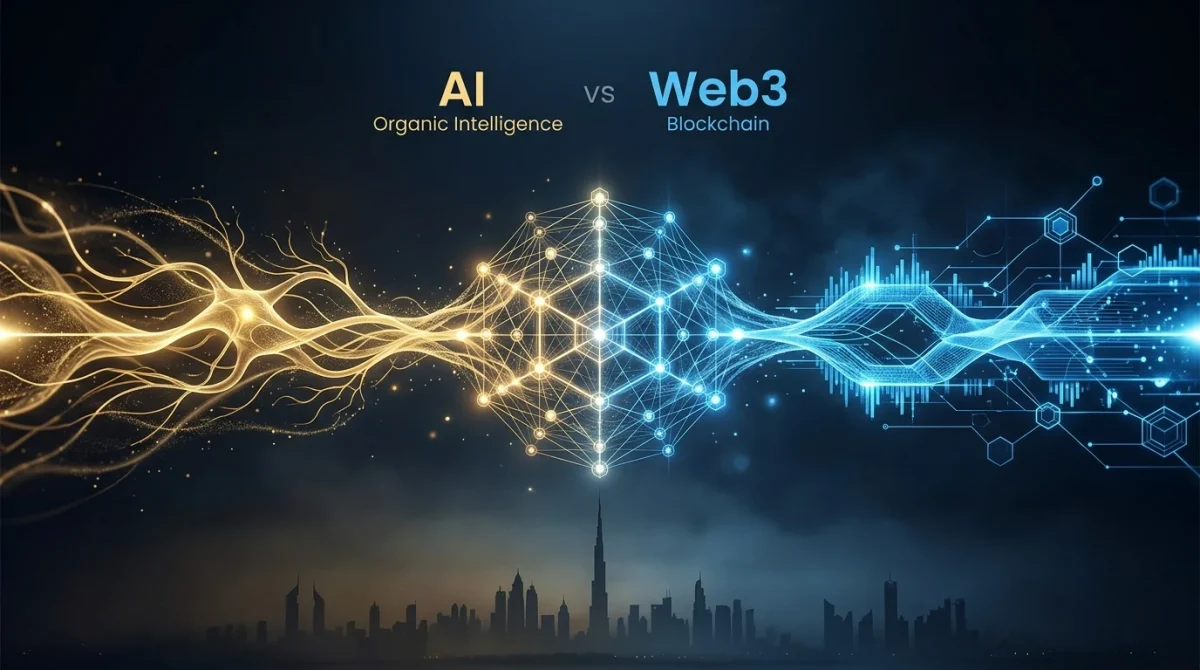

Can today’s most advanced AI models be trusted to operate independently in Web3 environments? According to the newly released Web3 AI Benchmark, the answer is no. The study reveals that leading artificial intelligence, blockchain, DeFi, smart contracts, and Web3 security models still struggle with some of the industry’s most critical tasks. Despite rapid advancements in AI capabilities, researchers found that no current system is sufficiently reliable for unsupervised deployment in high-stakes decentralized ecosystems.
Why Does Web3 Need Its Own AI Benchmark?
Artificial intelligence has benefited from specialized evaluation frameworks across industries such as healthcare, finance, and law. However, until now, the blockchain sector lacked a dedicated benchmark capable of measuring AI performance in real-world Web3 scenarios.
To address this gap, DMind AI collaborated with researchers from Zhejiang University and Nanyang Technological University (NTU) to create the first comprehensive benchmark specifically designed for Web3 applications. Their research paper, accepted at the prestigious KDD 2026 conference, introduces a rigorous framework for assessing AI reasoning in blockchain environments.
The goal is straightforward: determine whether modern large language models can safely assist with tasks involving decentralized finance, governance systems, token economics, and smart contract security.
How Was the Web3 AI Benchmark Conducted?
The benchmark consists of 3,543 expert-curated questions spanning nine major Web3 domains. These categories include smart contracts, DeFi protocols, decentralized autonomous organizations (DAOs), tokenomics, blockchain infrastructure, and security vulnerability analysis.
Researchers evaluated 31 leading AI models, including GPT-5, Claude, Gemini, DeepSeek, and Qwen. Rather than focusing on general knowledge, the benchmark challenged models with highly specialized blockchain scenarios that require deep reasoning and technical understanding.
The results highlighted a significant performance gap between general-purpose AI capabilities and the expertise required in real-world decentralized ecosystems.
Why Are Security and Token Economics Still Major Challenges?
One of the most important findings of the study involves security-related tasks. AI models consistently struggled when identifying vulnerabilities in smart contracts or evaluating complex token economic structures.
This weakness is particularly concerning because blockchain systems often operate without centralized oversight. Once deployed, smart contracts can be difficult—or impossible—to modify. A single oversight can result in substantial financial losses, protocol failures, or exploitation by malicious actors.
Researchers emphasize that mistakes in Web3 are fundamentally different from errors in other industries. In decentralized finance, inaccurate analysis can directly impact billions of dollars in assets and undermine user trust across entire ecosystems.
Can Additional Training Solve the Problem?

The research team also tested whether fine-tuning models on benchmark-specific data could significantly improve performance. The outcome was revealing.
Even after targeted optimization, performance gains remained limited. This suggests that the challenge is not simply a lack of training data but a deeper issue involving multi-step reasoning, technical understanding, and contextual decision-making.
Web3 environments require AI systems to simultaneously evaluate economic incentives, governance structures, security assumptions, and blockchain mechanics. Current models still face difficulties combining these factors into reliable decision-making processes.
As a result, human oversight remains essential for critical blockchain operations.
What Does This Mean for the Future of AI in Web3?
The acceptance of the research at KDD 2026 marks a major milestone for both the AI and blockchain industries. For the first time, developers, investors, auditors, and protocol teams have access to a standardized framework for evaluating AI readiness in Web3 environments.
The benchmark also provides practical insights into which models deliver the best balance between performance and operational cost, helping organizations make more informed decisions when integrating AI into blockchain workflows.
In parallel, DMind AI’s collaboration with Minara demonstrates a growing trend toward domain-specific AI assistants. Rather than relying on general-purpose models, the industry is increasingly exploring specialized tools designed specifically for blockchain, DeFi, and smart contract analysis.
Is Web3 Ready to Trust AI?
The findings make one thing clear: while artificial intelligence has made remarkable progress, it has not yet reached the level required for independent operation in the most sensitive areas of decentralized technology. The Web3 AI Benchmark provides the industry’s first scientific measurement of this gap and establishes a foundation for future improvements.
As blockchain adoption accelerates and AI systems become more sophisticated, the intersection of these technologies will continue to grow in importance. Organizations that understand both the opportunities and limitations of AI will be best positioned to navigate this evolving landscape.
If you would like to learn more about Web3 infrastructure, blockchain innovation, AI-powered crypto solutions, or emerging investment opportunities in the digital asset space, feel free to contact the Tokenova team. Our experts are ready to help you explore the future of decentralized technology with confidence.
FAQ
What is the Web3 AI Benchmark?
The Web3 AI Benchmark is a specialized evaluation framework designed to measure how effectively AI models perform across blockchain, DeFi, smart contracts, tokenomics, and Web3 security applications.
Which AI models were tested?
The benchmark evaluated 31 leading AI systems, including GPT-5, Claude, Gemini, DeepSeek, and Qwen.
What was the main conclusion of the study?
Researchers found that no current AI model is ready for fully autonomous deployment in high-risk Web3 environments without human supervision.
Why is AI safety important in Web3?
Errors in decentralized systems can lead to irreversible financial losses, security breaches, and protocol failures, making reliability and accuracy essential.