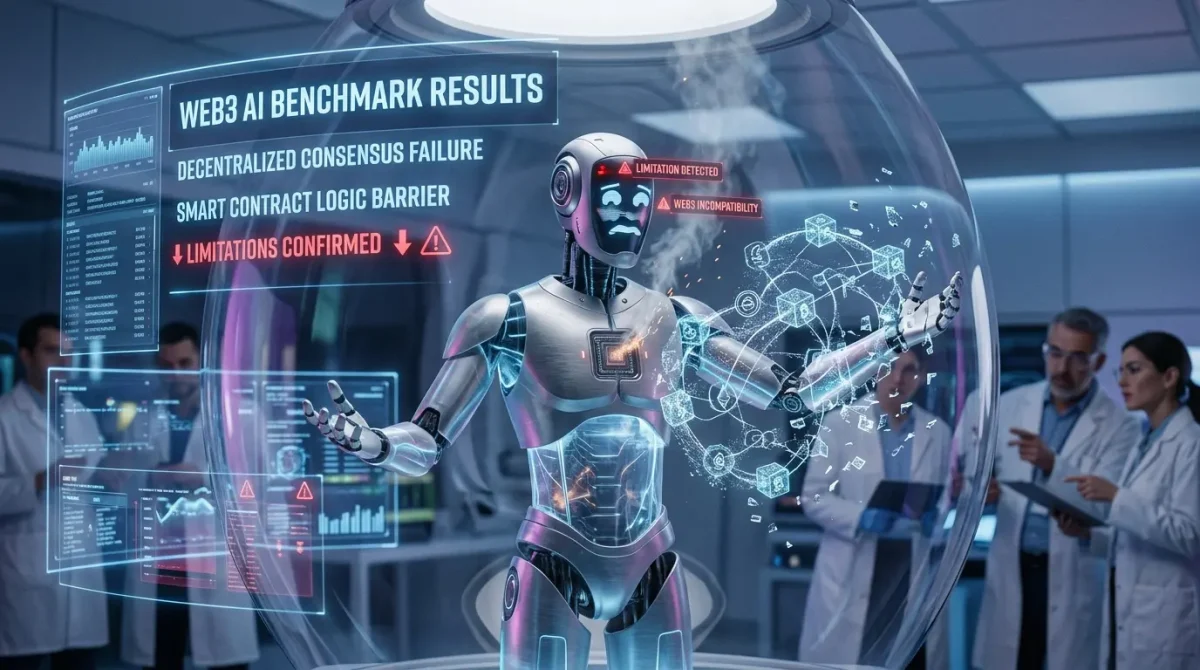

Can artificial intelligence safely manage critical tasks in decentralized ecosystems? According to the newly released Web3 AI Benchmark, the answer is not yet. The benchmark reveals that today’s leading AI models, blockchain systems, DeFi protocols, smart contracts, and Web3 security applications still face significant challenges when relying on artificial intelligence for high-stakes decision-making. While AI continues to advance rapidly, researchers found that no existing model can be trusted to independently handle the most sensitive responsibilities within the Web3 sector.
Why Was the Web3 AI Benchmark Created?
Over the past few years, industries such as healthcare, finance, and law have developed specialized benchmarks to evaluate AI performance. Web3, despite being one of the most technically demanding and financially sensitive sectors, lacked a dedicated framework for measuring AI capabilities.
To solve this problem, DMind AI partnered with researchers from Zhejiang University and Nanyang Technological University to create a comprehensive benchmark specifically designed for blockchain environments. Their research has now been accepted at KDD 2026, one of the world’s most respected conferences in artificial intelligence and data science.
The benchmark aims to answer a critical question: Can current AI models be trusted in environments where a single mistake may result in irreversible financial losses?
How Were Leading AI Models Evaluated?
The Web3 AI Benchmark consists of 3,543 expert-designed questions covering nine core areas of blockchain technology. These include smart contracts, decentralized finance, token economics, decentralized autonomous organizations (DAOs), blockchain infrastructure, and security vulnerabilities.
Researchers tested 31 leading AI models, including GPT-5, Claude, Gemini, DeepSeek, and Qwen. Unlike traditional AI evaluations that focus on general knowledge, this benchmark examines whether models can reason through complex blockchain scenarios and make accurate decisions in specialized environments.
The findings suggest that while these systems perform well in broad tasks, they still struggle when faced with the technical complexity and risk profile of Web3.
Why Does AI Struggle With Security and Tokenomics?
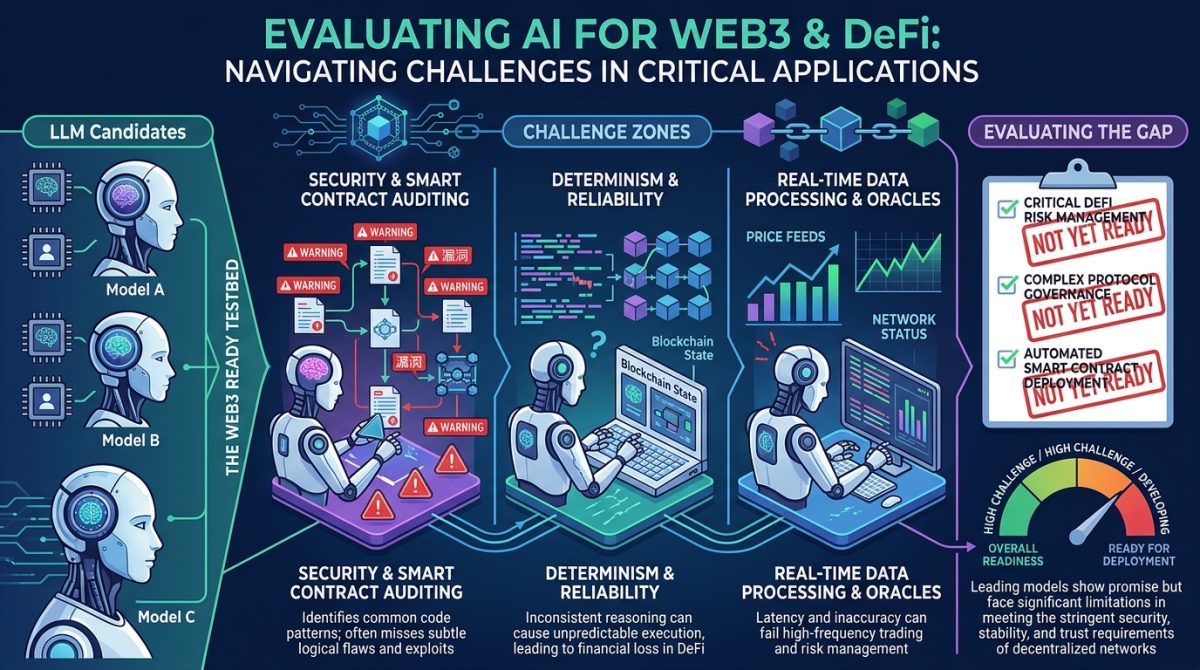
One of the most concerning outcomes of the study was the poor performance of AI models in security-related tasks. Detecting smart contract vulnerabilities, identifying attack vectors, and evaluating token economic structures proved particularly difficult.
This is a serious issue because blockchain networks operate in highly adversarial environments. Once a smart contract is deployed, vulnerabilities can be exploited immediately, often resulting in substantial financial damage.
Similarly, tokenomics requires an understanding of incentives, governance mechanisms, market behavior, and long-term ecosystem sustainability. The benchmark demonstrated that current AI systems often lack the deep reasoning necessary to accurately evaluate these factors.
For blockchain projects, this reinforces the importance of human oversight when making critical technical and economic decisions.
Can Better Training Close the Gap?
Researchers also investigated whether additional training could significantly improve AI performance in Web3 environments. Surprisingly, the improvements were minimal.
Even after targeted optimization and exposure to benchmark-related data, most models showed only modest gains. This suggests that the challenge extends beyond access to information.
Web3 applications demand multi-layered reasoning that combines economics, cryptography, governance, security, and software engineering. Current large language models can process information efficiently, but they still struggle to consistently apply complex reasoning across these interconnected domains.
As a result, AI remains a valuable assistant rather than a fully autonomous decision-maker in blockchain ecosystems.
What Does This Mean for the Future of Web3 AI?
The publication and academic recognition of the Web3 AI Benchmark represent an important milestone for the industry. For the first time, developers, investors, auditors, and enterprises have access to a scientific framework that measures AI readiness for blockchain applications.
The benchmark also highlights which models currently offer the best balance between performance and cost, helping organizations make more informed decisions when integrating AI into their operations.
Beyond evaluation, the research is expected to accelerate the development of specialized AI systems designed specifically for Web3 use cases. Rather than relying on general-purpose assistants, the industry is moving toward solutions tailored for smart contract analysis, governance assessment, risk management, and blockchain infrastructure.
Is the Web3 Industry Ready to Trust AI Completely?
The evidence suggests that the industry is not there yet. While artificial intelligence continues to improve at an impressive pace, the Web3 AI Benchmark demonstrates that significant gaps remain in areas where accuracy, security, and reasoning are essential.
The good news is that these gaps can now be measured and addressed systematically. By establishing a clear standard for evaluation, the benchmark provides a roadmap for future innovation and safer AI adoption across decentralized ecosystems.
As blockchain technology and artificial intelligence continue to converge, organizations that understand both the opportunities and limitations of these tools will be best positioned for long-term success. If you’re exploring Web3 opportunities, blockchain innovation, AI-powered solutions, or digital asset strategies, the Tokenova team is ready to help. Contact us today for expert guidance and personalized consultation.
FAQ
What is the Web3 AI Benchmark?
It is a specialized evaluation framework designed to measure the performance of AI models across blockchain, DeFi, smart contracts, security analysis, and other Web3-related domains.
Which AI models were tested?
The benchmark evaluated 31 major AI systems, including GPT-5, Claude, Gemini, DeepSeek, and Qwen.
What was the key finding?
Researchers concluded that no current AI model is ready for fully autonomous deployment in high-risk blockchain environments without human supervision.
Why is AI reliability important in Web3?
Because errors in smart contracts, DeFi protocols, or governance systems can lead to significant financial losses, security breaches, and long-term damage to user trust.